Johnny Thirkell Trumpet Interview
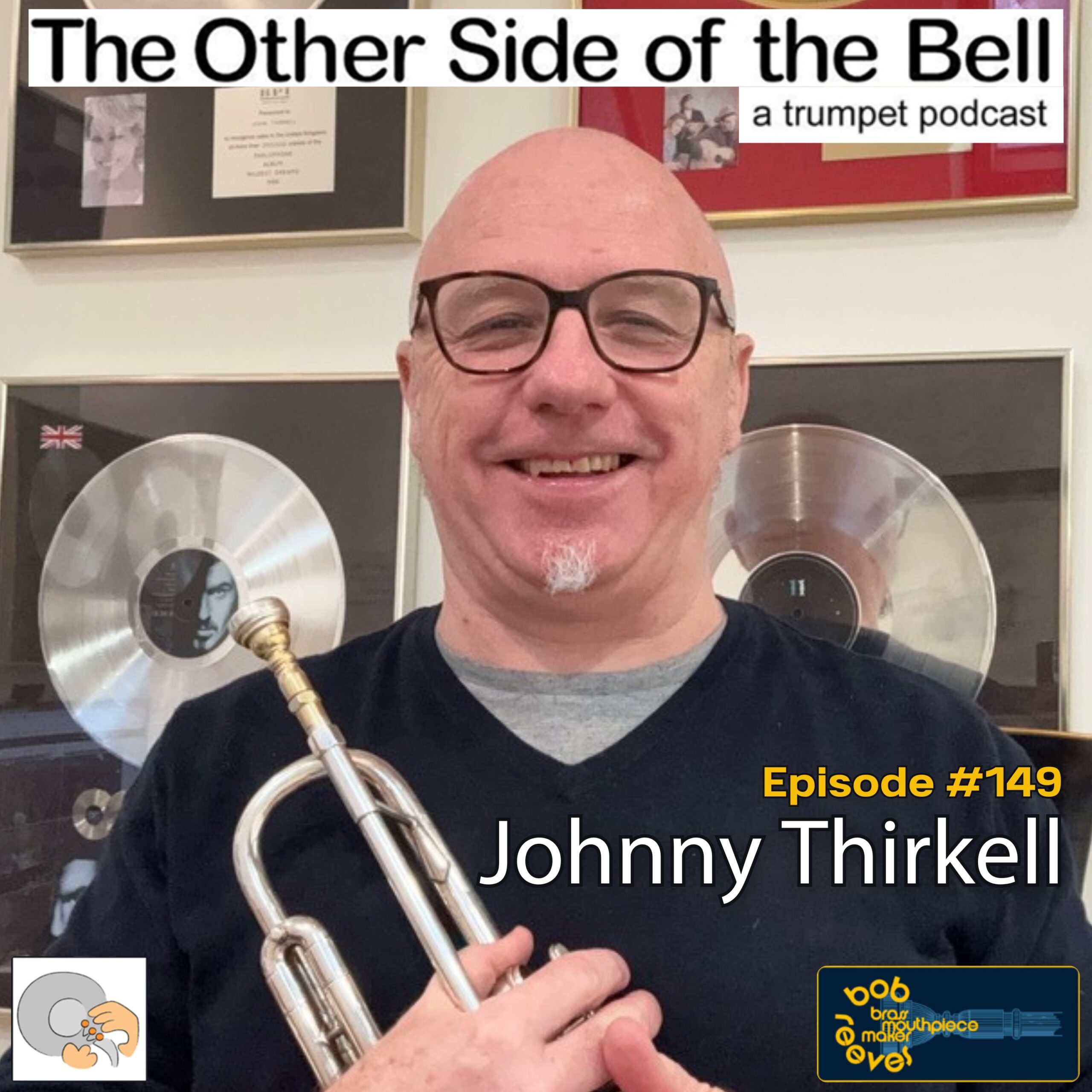
Welcome to the show notes for Episode #149 of The Other Side of the Bell – A Trumpet Podcast. This episode features trumpet performer and recording artist Johnny Thirkell.
Listen to or download the episode below:


About Johnny Thirkell
In a long and varied career, Johnny Thirkell has an impressive record of achievements and unparalleled experience as a trumpet player, producer and latterly as a tech entrepreneur.

Upon leaving Leeds College of Music, he studied trumpet in New York with the great Carmine Caruso before embarking on a playing career which would see him perform in many genres of music at the highest level. From the B.B.C. Radio Orchestra through the Buddy Rich & Gil Evans Orchestras, and on in to the Rock & Pop industry, Johnny established himself as a versatile and adaptable musician of the highest calibre.

A measure of his success lies in the fact that his trumpet playing featured on at least 1 album in the UK album chart, continuously, without a break for over 13 years, and at one point he was playing on 11 of the top 50 albums in a single week.
He has performed on over 6000 recordings, more than 100 top ten albums and 38 US & UK No.1 records, including the recent BTS global smash “Dynamite”. The list of Artists with whom he has recorded reads like a who’s who of the music industry and includes such illustrious names as:
- Jamiroquai
- Sir Paul McCartney
- David Bowie
- Pet Shop Boys
- George Michael
- Tina Turner
As well as touring and playing live with artists like Phil Collins, Eric Clapton, Bon Jovi and Ray Charles.

Johnny has been a regular member of 3 very successful groups:
- Swing Out Sister (1985 – 1988)
- Level 42 (1988 – 1994)
- Jamiroquai (1993 – 2000)
In 2024 he scored his 38th No.1 record with Snow Patrol’s “The Forest is the Path”
A natural progression was into record production and he has produced (or co-produced) over 250 commercial releases, and co-written many of the songs. Indeed, he has had over 500 songs published, including songs for artists as diverse as The Spice Girls (he co-wrote their early songs), Odyssey & The Three Degrees.
In recent years he has focused on building and selling a number of businesses in the music and technology space. Johnny also enjoys employing his communication skills and experience through writing and speaking, and is the Founder of Elite Music Camps – offering week-long residential music courses taught by some of the finest musicians in the world.


Johnny Thirkell episode links
Upcoming Bob Reeves Brass Mouthpieces Events
- Texas Music Educators Association Conference, Feb. 11-14, San Antonio, Texas
https://trumpetmouthpiece.com/products/tmea-valve-alignment-special -
Dylan Music, Feb. 26-28, Woodbridge, New Jersey
sales@dillonmusic.com -
National Trumpet Festival, March 20-22, University of Iowa, Iowa City, IA
https://trumpetmouthpiece.com/products/national-trumpet-competition-valve-alignment-special -
Metropolitan Music, April 10-11, Seattle, WA
https://metropolitan-music.com/https://metropolitan-music.com - Arkansas Trumpet Day, April 18th, Arkansas State University, Jonesboro, AR
Podcast Credits
- “A Room with a View“ – composed and performed by Howie Shear
- Audio Engineer – Ted Cragg
- Cover Photo Credit -Johnny Thirkell
- Blog Photo Credits – David Harrison
- Podcast Host – John Snell
Transcript
Please note, this transcript is automatically generated. It may contain spelling and other errors. If you would like to assist us in editing or translating this transcript, please let us know at info@bobreeves.com.
John Snell: Hello and welcome to The Other Side of the Bell, a podcast dedicated to everything trumpet brought to you by Bob Reeves Brass. We’ll help you take your trumpet playing to the next level. I’m John Snell, trumpet specialist here at Bob Reeves Brass, and I’ll be your host for today. Joining me today is trumpeter Johnny Thirkell.
We’ll get to Johnny’s interview here in a moment after a word from our sponsor and some trumpet news.
[00:01:00]
JOHN SNELL: Well, I hope everyone had a wonderful holiday season. I got a lot of great feedback from our, uh, special holiday episode as I like to call the hastily thrown together, uh, holiday episode. It was a lot of fun. Uh, huge thanks to, uh, everyone who joined in, on that. And if you didn’t go back and you still [00:02:00] wanna, uh, spread the holiday cheer, go to YouTube and check out, uh.
The, uh, holiday special, and I’m already planning 2020 six’s holiday episode. I’m not gonna plan it at the last minute. and even with my poor planning, I think it turned out to be, quite a lot of fun. so check that out. Uh, thank you for all the great feedback from that. I just got back from Atlanta, uh, actually more specifically Kennesaw at, at Kennesaw State University for the Trumpet Festival of the Southeast. huge shout out to Dr. Stephen Wads for putting a fabulous event together. He was the host this year. And, uh, if you haven’t been, to one of the trumpet festivals, uh, they move it around around the southeast.
check it out. they had a great festival. They had Ashley halt. It was wonderful to see her. I, uh, did an alignment on her cornet while she was there. Uh, Kellen HNIs was there. And, uh, as the artists and, uh, I mean, I think they had over 200 trumpet players in attendance, and a lot of you came by the booth.
Uh, shout out to Jonathan and Joel and Seth and, you know, I need to [00:03:00] be better at writing names down. I, I was doing the booth by myself this time. Uh, so I was running around like a chicken with its head cut off doing alignments and selling guard bags and mouthpieces and stuff. but a lot of you came and, mentioned that you were podcast listeners and uh, really means a lot, whether I remember your name for the shout out, or not. Uh, it really did mean a lot. It was a great trip down there. special shout out to, uh, my buddy Scott Mackey for keeping me fed. Uh, we had a wonderful lunch on setup day and he insisted on bringing me a sandwich on the exhibit hall day ’cause I was, uh, all by myself and it was a lifesaver.
So, Scott, if you’re listening, thank you. Very much for that. coming up, get out your calendars, get out a piece of pen, paper, and a pencil or pen, because we are hitting the road this kind of first quarter, first third of 2026. coming up next, uh, TMEA, the huge event in San Antonio, Texas, February 11th to 14th.
The alignment link for that is live. Uh, so we’ll have that for you. [00:04:00] Or you can just go to the trumpet mouthpiece.com and type in TMEA and that will pop up. That event sells out. Every year we have to turn people away on Saturday because, uh, I can only do so many alignments at the show. Uh, so if you want to guarantee a slot that your alignment gets done, at the convention at uh, TMEA pre-order, get that slot and we will guarantee you get the horn done.
so we’ll have the link to that and if you’ll be there, February 11th. 14th. Come on by. We’ll have guard bags, some Shires horns, some Vin mutes, and the Traveling Road Show of 350 Reeves Mouthpieces. not too long after that, the long awaited trip to Dylan. Music in, uh, Woodbridge, New Jersey. The dates for that February 26th to 28th, they are handling.
The, uh, alignment reservations. So reach out to Dylan Music, dylan music.com, uh, for their, phone number and email address. Uh, Jim, I think, [00:05:00] is organizing all of that if you know Jim McCombs there. so reach out to them and get on the list. Again, we sell out there. It’s just, you’re gonna sense a theme here with the valve alignments, uh, and the demand for them.
Again, the dates for Dylan Music February 26th through 28th. And of course, if you already have your, uh, valves aligned, you want to come by and say hi, come on by. We will have the, uh, traveling roadshow. We’ll have all the mouthpieces. We’ll have some old and mutes and some other fun instruments. I think we’re bringing some Charlie Davis trumpets to that one as well.
A few weeks after that, we are going to the National Trumpet Competition. I believe it’s in Iowa City this year. Uh, hopefully I’ll figure that out before I book my flight. Uh, but if you are going to NTC, the dates for that are, Friday, March 20th through Sunday, March 22nd, at least the exhibit hall hours.
I think the competition runs a little bit longer, either before or after. so March 20th to the 22nd in, Iowa, we will be there with the whole shop [00:06:00] as well. And the link for that will be up and. I told you there was gonna be a theme we sell out every year for alignments at NTC.
So book those slots. Uh, and I forgot to mention, for, uh, for TMEA and for NTC, we do discount $25 if you book in advance. Uh, and the reason for doing that one, it kind of sweetens the deal a little bit. And also it’s nice to know before we show up someplace how busy we’re gonna be. And so, that’s why we discount a little bit if you pre-order in advance.
And it’s nice to know when we show up someplace, there’s some kind of control over how many alignments we’re gonna do. Uh, so again, the links for N TC will be in the description and on the show notes. And if you don’t wanna look there, go to trumpet mouthpiece.com and just search for a national trumpet competition.
Uh, we are heading to Seattle. This is our first trip to the Pacific Northwest, uh, at least specifically Seattle. We did an Adam Fest, up in [00:07:00] Ellensburg a few years ago. our dealer, metropolitan Music, now they have two locations, uh, Seattle and Kirkland. We will be at the Seattle location and the dates for that are April 10th and 11th.
That’s a Friday and Saturday the week after Easter. So you can use all that Easter gig money and come get a new mouthpiece or get a valve alignment. Paul McVicker or Paul and Jean McVicker, one of run a fabulous store up there. They’ve been carrying our mouthpieces for decades and, uh, they’ve had an open invitation, for us to go up and visit the Pacific Northwest and we were finally able to make it happen.
So we’re really excited. to be up in that area for the first time, and, uh, also to be hosted by a fabulous store in metropolitan music. So again, the dates for that April 10th and 11th, I believe they are handling the alignment schedule. you can reach out to them, uh, if you are interested, but we’ll get more details.
That’s still a few months out yet, so as soon as when we get closer to that, I will get the details, for our trip to Seattle. And [00:08:00] last but not least, at least in the first third of the year, uh, is gonna be Arkansas Trumpet Day, and that’s held on April 18th at Arkansas State University. our good buddy, NY RM Samoas, uh, doctor NY RM Samoas, sorry.
I gotta gotta use the title. Well-deserved, title, uh, trumpet professor down there, throws that, annual event and, uh, we’ve sponsored it in the past. And, we will be there this year. Uh, again, it’s only one day, but we will be able to do a few of valve alignments and we’ll have all of the stuff. So there you have it.
Hope you wrote some of those down, and hopefully we will be in your neck of the woods. You can come say hi. At the very least, you can come try mouthpieces. And probably the biggest opportunity since it’s, harder and harder these days to ship your horn or more expensive, I guess is more like it, to get your valve alignment done there on the spot at one of these events.
okay, that’s. All the information I have. oh, one last thing. Uh, I am at the NAM Show this week, which if you’re not familiar with, is the [00:09:00] National Association of Music Merchants. it’s generally not open to the public, but that’s where all the big, manufacturers go big and small. Uh, meet with dealers and things like that.
I bring that up because, guard bags is there. And they bring usually between 40 and 50 trumpet bags. and we buy the booth out every year. So we’re gonna get, I mean, if you can see behind me if you’re watching this, uh, we still have some of our inventory left from our last order, but they bring some fun things.
they bring some of the carbon, uh, I mean, yeah, the carbon fiber or the, sorry, the fiberglass, uh, bags. They bring some of those, they bring some one-off styles that we don’t normally carry or some of the other dealers don’t carry. actually I have one here that they shipped to us that’s like a lizard, uh, skin pattern.
You know, those, the crocodile print that they have has been very popular. And this one’s more like a lizard, smaller scales, if you will, pattern. I might pick that one up for myself. but anyway, I wanna give, uh, my podcast listeners, uh, first dibs on them. So, check out our [00:10:00] website. Probably better place is check out our social media.
I, I post photos of them on our Instagram, stories and they’re one-offs. So we have one in stock and it’s first come, first serve.
So if you’re interested in picking up a, a super cool guard bag or a one-off, something like that, make sure you follow our Instagram at Bob Reeves Brass and keep an eye there and on the website, cause you can pick up a, a super cool bag. Well, that’s all I have today. I’m really excited about today’s guest. Johnny Kel, has been a customer for years and a good friend and podcast listener. So, a devoted podcast listener himself. fabulous player, fan of his playing. And, uh, he’s, you know, started his own businesses, sold businesses, um, so knows the ins and outs all around, not just of the trumpet playing side of the business, but, um.
the other production sides, uh, and licensing, things like that. So we get into that. So without further ado, here’s my interview with Johnny.
JOHN SNELL: My special guest today, Johnny Kel, is a world-class trumpet [00:11:00] player, producer and tech entrepreneur whose career spans everything from big band and jazz to the highest levels of rock and pop. After studying at Leads College of Music, he trained in New York with legendary Carmine Caruso. Then went on to perform with ensembles, including the BBC Radio big band, and the Buddy Rich and Gil Evans orchestras before becoming one of the most in demand studio musicians in the uk.
His trumpet has appeared on more than 6,000 recordings, including over 150 top 10 albums and 38 US and uk. Number one, records with credits alongside artists like Jamo, Paul McCartney, David Bowie, George Michael, and Tina Turner. Plus touring with Phil Collins, Eric Clapton, Bon Jovi, and Ray Charles. Johnny was also a longtime member of Swing Out Sister, level 42 and Jamiroquai, and in 2024 he notched another number one with snow patrols.
The forest is the path. [00:12:00] Beyond playing, Johnny has produced or co-produced over 250 commercial releases, co-written and published more than 500 songs, and continues to share his experience through writing and speaking.
Johnny is also a published author having just published his memoir, blown It A Session, musician’s Life Behind the Scenes, which we’ll talk a little bit about in this interview. So without further ado, here’s my interview with Johnny Kel.
JOHN SNELL: Well, I am so excited to have joining me from across the pond, Johnny, Kel, Johnny and podcast listener too. This is I am so thrilled.
How are you doing over there? He said the weather is typical, uh, London
JOHNNY THIRKELL: That’s right. Welcome to England, right?
It’s gray and easily. my wife is from Zimbabwe and she has a theory that the reason why the UK is sort of renowned for the arts and science, and Zimbabwe isn’t, is because in Zimbabwe they’re outside playing and we’re inside working on science projects or something.
JOHN SNELL: [00:13:00] Sip sipping tea and watching cricket. Yep. Well, yeah, here we are, the thick of January, and I’m wearing short sleeves and I probably could have gotten away with wearing shorts
JOHNNY THIRKELL: Oh man,
JOHN SNELL: yeah, think about all us in Southern California that are
JOHNNY THIRKELL: My heart.
JOHN SNELL: in this winter out.
Let’s let’s talk about the trumpet as much as I love weather. And let’s start like with the beginning. How did you get started?
JOHNNY THIRKELL: I actually started, it was actually, to get outta double maths at school. Math, you would
maths.
JOHN SNELL: Yeah.
JOHNNY THIRKELL: I was quite a late starter about 14 or something like that. and I spotted every week this kid, a couple of rows in front of me, he would get, he would just get up like half an hour, 20 minutes before the end of the lesson and just stroll out.
And, um, nobody said a word to him. I thought, wow, I’ll have some of that. Anything to get out of, uh, the last 20 minutes of maths. So it turns out this guy, his name is Ken Brown, and he actually ended up as, as second trumpet in the Hale Orchestra here in, but at the time, he was a local, he played in a local band.[00:14:00]
So I called him break and said, what’s all that about? And he said, I’m in the school band and I, I, you know, I get to leave half an hour early so I can, I can set up all the music and write, where do I sign? Okay. So that was really what started it. Just an excuse to get outta I’ll do anything,
but actually, I took to, it just instantly I fell in love with this thing. You know, the, in those were the days, and I’m not sure how it is in the us but, but here in those days, you know, the late 18 hundreds we used to I mean, you would get, you’d be given an instrument and a weekly lesson for free.
It cost nothing.
And
JOHN SNELL: school, through the school
JOHNNY THIRKELL: all through school. Yeah, all at school. And so they gave me this corner as it was then, uh, so often the case here, right in the uk. and I took this thing home and man, John, it was like opening Pandora’s box. It was the most, I just fell in love with this thing instantly. And from then on, I abandoned all ideas of schoolwork and came home from school and just practiced until somebody shouted [00:15:00] at me or it was time to go to bed. and that was it. And I grew up in the northeast. Of England, which is a region where there are a lot of, collary bands. You know, every, you know, I lived in a, in a mining village.
In fact, when I left school, I, I was a coal miner for a couple of years before I went to college.
And every village has its own brass band. so the course, the, you know, unlimited opportunity for me to, uh, you know, fulfill any musical sort of wishes I, I wanted. So, yeah I came up through the coy bands and yeah, when I
left school,
JOHN SNELL: Which, one did you play in,
JOHNNY THIRKELL: I’ve had, in a number of them, there’s a, that Easington coy band was the one, my sort of primary one.
And then as I got a little bit better, I went into a band called Ever Ready.
JOHN SNELL: Mm-hmm.
JOHNNY THIRKELL: And then many years, well, not that many years yet. When I was at music college I was friends with Ray Far. I called Ray Far who was then conducting the Grime tho Cory Band. And I did a little bit with those guys, but you know, I didn’t have a particularly impressive brass band career.
[00:16:00] But brass bands a, I mean, it’s almost the perfect training, I think, for what I wanted to be, which was a studio musician. That’s all I ever wanted to be.
From the, you know, from the very early days, I had no, no thoughts of being an artist or, you know, I just wanted to be, I, I love that the idea of every day being a different challenge, you know? so with brass bands, of course, you’re playing, there’s two, three rehearsals a week
and every week you’re sight reading all the time. All the time. So they’ll, they just bring out new pieces and they’d, it’s such a great training ground, you.
JOHN SNELL: Interesting. You see, I have something I wouldn’t have known. I would assume that you had a concert repertoire or a competition repertoire that you’re practicing over over and over again. And
JOHNNY THIRKELL: The,
JOHN SNELL: they’re reading lots of material,
JOHNNY THIRKELL: sure, the drill, you would sort of be the first, so may maybe you’re working towards a contest, a band
contest. so generally speaking, it would be the second half of the rehearsal would be the test piece. You’d be working through that. But al always the first half of rehearsal, there’d be four or five pieces or something, [00:17:00] which you would the librarian would just kind of pull them out, all these musty smelling yellow page sort of brass band charts.
He’d, he’d hand them out and we’d, we’d site read. Does it? So from a, from an early age, I, as I said, I’ve got 14, I think when I started, by
the time I was, 16, I was sort of very active in the brass band, scene. And yeah, getting read, you know, I’m reading pieces, all of the, you know, all of the time.
JOHN SNELL: Interesting. And so you brought up that you early interest in studio. Did you, I mean, uh, music, uh, did you have someone in the family or how were you exposed? ’cause I mean, a lot of young kids growing up don’t even know what a studio musician is unless
they’re, have some sort of access to that, you know?
JOHNNY THIRKELL: yeah, I think, well, I mean, perhaps not at that such an early stage. Uh, I didn’t have aspirations towards being a pseudo musician, but once I had sort of determined that this was going to be my career, then, you know, you explore, you have a look at what’s out there and what’s available. And for me it was the, you know, the challenge of doing something different every day.
You know, you turn up at the [00:18:00] studio, you have no idea what it is, who it’s for, what kind of music it is. And I just love that. that’s the buzz. I really enjoy that and I
particularly enjoy it. In the pop music field, often there is no chart. You know, I mean, sometimes I will do the chart. Sometimes someone else will do the chart, but often you go there and the guy puts the record on and stands back and wait for you do thing. And that’s my favorite. I love,
JOHN SNELL: do something. Go.
JOHNNY THIRKELL: I mean they, it’s literally
like that, you know, you are the experts back on.
JOHN SNELL: I just pushed the three valves down. Come on. What do you mean?
so was you started on cornet when did you get your first trumpet? When did, was there a crossover or were
JOHNNY THIRKELL: Oh my Lord.
Yeah. Yeah.
There absolutely was. Yeah, it’s when I went, when I left school and I went and I was, worked at the local quarry,
JOHN SNELL: Mm-hmm.
JOHNNY THIRKELL: took me about 10 minutes to work, think, well, I’m, I’m not doing this for the rest of my life. You can forget that. So I better, you know, I better think of another plan.
So I went to night school, I got some more [00:19:00] qualifications, you know, A levels here. And I applied to the colleges, I applied to the Royal Academy Music, the Royal College of Music and the Royal Northern College of Music. but of course, at the point of application, John, I didn’t even own a trumpet. You know, I was still a corner player, and so
I’m such a halfwit. I, I’m, I literally bought a trumpet like two weeks before the auditions. Oh, no. I know. And of course as you might imagine, I didn’t get in into any of them. I mean, I went I think I did the humel or, or maybe, you know, the hide or the humel.
and I’d never, ever even heard a recording of it. I just, I was such a naive idiot. But of course, I, I. I didn’t get it anywhere, none of them. And in fact the professor at the Royal Academy, he said to me, you know, you don’t really have what it takes for to play the trumpet. if I were you, I would go back up north and, and, stick with the corners. It’s almost like being a professional, you know, they’ll give you a good job in the pits and, and, which [00:20:00] is actually exactly what I did. so I, I put it in a cupboard for maybe a year or a year and a half or something like that,
for a very humorous story. I, well, I think it’s humorous. Um, I was auditioned by, at the Royal Northern College of Music by the Great Morris Murphy, who was then about to take up the position as principal trumpet with the LSO. and of course, I didn’t get in. And then many years later, maybe 10 years later I was booked on a session. A film, like a film session. It’s the first time I’ve come across it.
and, you know, in the break, you know, Morris said, it’s really nice to meet you. I’ve heard about you and blah, blah, blah.
It’s nice to play together eventually. And I said, actually, we have met before, so, oh no. I said, yeah I, you auditioned me at the Royal Northern College about 10 years ago. Oh my lord. He said, did you get in? And I said, no. And he said to me there, I remember now. You were rubbish. That’s actually that’s Maurice’s, you know, [00:21:00] he said, I’ll buy you a pint to say sorry.
So that was it. Yeah. But there we
JOHN SNELL: What a full circle. I love it.
JOHNNY THIRKELL: For sure. For sure. Look, I there’s in no way, John did I deserve to get into any of those places? You know, I was a hapless idiot
who bought just literally two weeks before the audition, I bought my first trumpet.
JOHN SNELL: what, trumpet was it? I’m curious
JOHNNY THIRKELL: Well, it was a Getson Caravel, I can tell you. It was a cheap, very cheap. I still play Getson to this day, but
not the Caravel a very cheap student model. It’s the only one my folks could afford.
so I say, no way did I deserve to get but it made me go away and think hard, long and hard about things, you know? And
okay, if you wanna do this, then you’ve got some work to do, John.
JOHN SNELL: Yeah. Oh, the, what a story. And, but the perseverance to, to do that, to get turned down. And so you were, you were still practicing when you were working in the, so how long were you in the
JOHNNY THIRKELL: But a couple of years, maybe two, two
and a half years, something like that. Yeah.
JOHN SNELL: I mean, were we actually going down in ’em and
JOHNNY THIRKELL: Yeah. Yeah. Look, I
JOHN SNELL: see on in the movies?
Yeah.
JOHNNY THIRKELL: I [00:22:00] wasn’t at the coalface with a pick, John.
But Yeah.
I, my, I worked in the stores department and I had to go underground and travel around the pit and just take, find out what equipment people needed, and then go
back up and put it all together and take it back down there.
So
it’s not the greatest way to earn a living, right?
JOHN SNELL: and then practicing at night and still playing in the
JOHNNY THIRKELL: Yeah.
I’m playing in the Collary band. Yeah,
JOHN SNELL: Wow. so then what turned around for you then during that, uh, after you got, you said you, you joined, you started playing cornet in the theater, that sort of thing, and.
JOHNNY THIRKELL: yeah. Well, I went back up north like they suggested, and I went back to the pit, but I thought, no, this is not for me. I, I I didn’t want to do this for the rest of my life, so I, it made me sit down and take account of my you know, take stock of where we were. Okay. John, if you want, if this is what you want, then you’ve gotta put the work in.
You need to, and I found, a guy who lived locally and I’m sure that there are these guys that have dotted all around the world, right? This is a guy, he’d been in London some, you know, years before. I think he played in the Eric Delaney band or something,
you know, like in the fifties. he lived up near to where [00:23:00] I was and he kind of took me under his wing.
his name was Russ Nicholson. God, God rest his. So, and yeah, he kind of took me under his wing. He played in a, in a, like a working man’s club, in a really rough part of a town called Middlesborough. he didn’t, he wasn’t a teacher as such. But he was a sort more of a mentor, you know, and I found it ended up I would, I would drive him to work in my car. I would do the gig for him and he would get paid, but
JOHN SNELL: Mentorship.
JOHNNY THIRKELL: Not really sure how that happened, John. But I can tell you it was worth every single penny because, you know, that sort of initial, you know, you’re beginning the seed training if you like, you know what it is to be a, professional musician.
Right. And your outlook and approach. Mean, it was definitely worth it. And so, yeah, from there, I then applied to go to Leeds College of Music, which is at the time it was the only, educational institution in the UK that had a, a co, a bit like Berkeley, that had a course in, in jazz and like [00:24:00] music jazz and popular music.
I’m sorry.
So I applied there and, and. By some miracle I got in and that was it. That, you know, and I was on my way. Then once I’d left home, there was no going back.
JOHN SNELL: That was it. Wow. And what, was it still on the same getson, or had you upgraded the trumpet by then?
JOHNNY THIRKELL: No. Well, I’m not on the caravel. No, I got rid of that. Pretty sharpish. But I play and have played, a 1964 gets an Turner doc Severson model, and I, that’s the trumpet I’ve played my entire career. I’ve got two of them, a
60. The, my, the first one was a 64, and then I, as a spare, I found a 62, about 20 years ago.
And so I used that as my double, you know, my double tracking trumpet.
JOHN SNELL: do you like the medium, large, like doc or the large bore, like snooky?
JOHNNY THIRKELL: it, well, it’s the large bore, the one I have. Yeah. I do like it. I do like a large bo Yeah, I
think I’ll put some shifts, some air really.
So Yeah.
no they, but they, It’s funny how the trumpet world has changed, right? When back then, you know, you had a binge or a [00:25:00] bark or, you know what I mean, that there was sort of, here in the UK it’s gone very, very sort of independent now, and there are, there are,
there are dozens and dozens independent trumpet makers, Taylor trumpets and all kinds of stuff like this. And that seems to be the way that British trumpet players have gone. I’m just a bit too scared John to change, you know what I mean? This trumpet I’ve had, it’s done, it’s worked for me. I’m, I’m still getting away with it somehow. And
so, you know, I don’t really see any reason to change unless it falls apart in my hands, which is very possible.
JOHN SNELL: With how many miles you have on it.
JOHNNY THIRKELL: Oh my lord.
JOHN SNELL: so you go to Leeds I mean, are you starting to freelance at this point? Well, you are already freelancing and, you know, mentoring with Russ and, you know, playing around. So is that continuing and
you getting into more of the production
JOHNNY THIRKELL: Yeah.
Well look, because I had worked for a couple of years, and again, at that time in the uk your education was paid for, your college was paid for, the government paid for it. Unless, like me, you had worked for two years. If, if you’d worked for [00:26:00] two years, then you had to, you didn’t qualify for the grant.
you were classified as a mature student. Right. Good luck with that. I don’t even think I’m that now. But, so I had to work my way through college, so I, I played in a, in a nightclub, Wednesday, Thursday, Friday, Saturday nights in a, in a club to, to sort of pay my way through.
JOHN SNELL: What kind of stuff?
JOHNNY THIRKELL: You just a covers man, you know, just, it was just covers of the sort of pop hits of the day really.
which was fine. It was great fun. and in the band with me was, it was a guy called Pete Beel, who’s now currently, you know, very renowned, you know, one of the top trombone players in London. you know, so it was obviously a great grounding for the two of us. And then what happened, John, was I was in a pub in Leeds, this is where the college was. And a guy, a friend of mine, he introduced me. He said, oh, John, you, this is Mike. He introduced me to this guy, Mike Potts, his name was Mm. And he said, you know, Mike, this is Johnny’s trumpet player, blah, blah, blah. So we, we get chatting and the usual gets around to, you know, what are you up [00:27:00] to? And this kind of thing. and I said to Mike, what, so, you know, what are you doing these days? And he said, oh, I’m in a band on the QE two. The cruise liner said, wow, man, that must be. Remember I’d been digging coal 18 months previously. Right. It,
different world. That must be amazing. And he said, I’ve enough now, you know,
So I’ll do it. Okay. Really? So he, I said, yeah, of course. I’ll, I said, what about college? What about it? and he said, well, when can you start? I said, well, when do you want me to start? He said, how about next Tuesday? Okay. Done.
JOHN SNELL: Like literally the
JOHNNY THIRKELL: Yeah. So I finished my beer and went home and packed my bags and drove down to South Hampton on the next Tuesday course. I discovered the Carmine Caruso book,
you know, calisthenics for Brass, and I was an absolute devotee of this. And my, the big driver for me, getting onto the QE two, is it go, [00:28:00] they go to New York, right?
Twice a month. And so, that for me was a route to getting lessons from Carmine Caruso, which I did,
JOHN SNELL: So you already had that forethought,
like when you
JOHNNY THIRKELL: no, at this step, by this stage, I was totally invested in being a, professional musician.
JOHN SNELL: Mm-hmm.
JOHNNY THIRKELL: And so, yeah, the opportunity to get to New York and get paid to do it, was just too good for, to, you know, much as my folks would’ve liked me to, to, uh, get a qualification I was more interested in, in playing, just playing the trumpet and getting better at that. So, yeah, I, if I was very, very fortunate we would land in New York twice a month and I would have a lesson with Carmine, and it was amazing. Amazing.
JOHN SNELL: Incredible. So you just, you sent, you send a letter to the school and say, Hey, sorry, I’m done, or what did
JOHNNY THIRKELL: I don’t think I did you know, John? No.
JOHN SNELL: you just picked up and
JOHNNY THIRKELL: Yeah, that’s the impetuosity. And also the, these, the selfishness of youth is unbelievable. You know, my mother rang, so I living in, dig in digs with a landlady
[00:29:00] in Leeds and my mother rang Mrs. Dodge, her name was and my mother rang Mrs. DODs and said, oh, can I speak to John?
And she said, oh, he went on the QE about two months ago.
JOHN SNELL: You didn’t even tell your parents, so, so what was it like joining the cruise ship? I mean, you did they have charts for everything? I mean, I know the cruise ship gigs, you’re supposed to do a little bit of everything, right? Shows and
JOHNNY THIRKELL: Yeah, it’s, Yeah.
look, it again, it’s, this is good all round training. You know, you’d
play some dance music, you’d play, there’d be reading, you know, there’d be artists would come onto the ship and you know, you have to rehearse. And it’s a perfect training for sort of entry into the general music industry.
JOHN SNELL: Mm-hmm.
JOHNNY THIRKELL: And I found it really useful. And it was great fun. we got up to some real escapades. I mean, how I didn’t get arrested or, or deported or something, I don’t know. But there we go. The, again, the impetuosity of youth. but for me, the, the main thing was to get to Carmine car. And again, you know how, [00:30:00] you know, how Fortune plays such a big part in like, just being in the right place at the right time. I needed aug. The flu horn I had was like falling apart. So on my first trip to New York on the ship, I go up to Elli, I’m going to get myself a new and I matching again. That’s the, I play to this day. This is 1978. I’m talking about
JOHN SNELL: Mm-hmm.
JOHNNY THIRKELL: because I’m old. And so I go to Elli and I spent a wonderful day playing every flugel they’ve got, every instrument they have, you know, and eventually I, I alight on the, this, the gets and turn of frugal. So I’m standing around the guy writing out the bill and, you know, all this sort of stuff and, and I said, lemme, can I ask you? I really would like to track down Carmine Cara, who trying to try see if I can get some lessons. You wouldn’t have to know how I might find him, you know, and without looking up, he pointed out the window, he said is, that’s his office right across the road there. [00:31:00] Carmine had, his office was on West 46, so, so that was it. I’d buy my new Ugal horn and I’d go downstairs and across the road and up to Carmine’s office. And I waited outside until he was free and, asked him for lessons.
JOHN SNELL: Amazing. So what was your first lesson? Like what, do you remember the first one?
JOHNNY THIRKELL: you know, he was an extraordinary guy.
JOHN SNELL: Mm-hmm.
JOHNNY THIRKELL: I mean, he said to me okay, well look I’m just about to go home now, so can you come back tomorrow and we’ll have, we’ll I’ll, you can have a little play for me and we’ll see. Unfortunately, I can’t really, and I’m working on the QE two and we, you know, we’re sailing down to Puerto Rico tonight. so we said, okay, alright, fair enough. Let’s see you play. So I get out the flu, it’s the only thing I’ve got and I play something. And he said, okay, yeah, I think we can, I think we can work with that. So, he said, I’m pretty tight, but I’ve got a slot. Like, you know, I can, let’s like Tuesday afternoons at three o’clock. so I said, well, that’s our next problem. Right? You know, you know, I’m not here regularly right on the ship. I, it’s here very kind of, you know, on and off, right? I’m [00:32:00] here regularly, but not, you know, not a set slot every week. he said, look, come back to me next time you’re here with your schedule and we’ll work something out.
And he was so amazing. He found
a slot for me on whatever days I happened to be in New York.
He found a slot for me. And uh, I, I think the bottle of Lare that he used to take for him every week used to oil the wheels of his diary somewhat.
JOHN SNELL: That’s
JOHNNY THIRKELL: but
but for me it was, it was absolutely, you know, I’d never really had a proper good quality. Teacher, even a college, you know, I had a, a, a guy, very nice guy, no names, no Patel, but he was a
classical player and he was out and out and of course today there’s much more crossover, right? You know, you, there’s, there’s, I know a million guys who are awesome at both,
right? Commercial and classical.
But then he was very sort of regimented. and my teacher at the college there I put him in as a de at my gig at the nightclub, and the next day, the band leader said, I don’t know who that G guy was last night, but don’t send him again. He was [00:33:00] hopeless, you know,
so
JOHN SNELL: Can’t.
JOHNNY THIRKELL: That was my trumpet teacher. But I mean, look, he was teaching me something that, you know. He was teaching me to play in a way that I didn’t really want to play,
you know? so it’s, I’m not sort of casting aspersions on him, but Carman Cara was the first proper grownup teacher that I’d had
at rest of the time, and largely sort of taught myself. And this was like a mind blowing experience. The idea that you would think about things, you know, until that point I just stuck the trumpet on there and blew. and I think the biggest impact the Carmine had for me was the mental approach. You know, often we would go, I’d go a whole lesson and not play a single note, and I’d walk out of the class just feeling like the greatest trumpet player in Christendom, you know.
JOHN SNELL: Wow. Wow.
JOHNNY THIRKELL: Of sort of, you know, he would say things like, you know, well, you know, it’s the easiest thing in the world is just you can split a top f before you’ve even put the trumpet on your face. Right? It’s all in the, it’s all in [00:34:00] your mind, you know?
And that, that’s something which I’ve been, I have been and still am very fascinated in the mental, John, you are a trumpet player yourself.
You know what it’s like, right? You turn the page and there’s a, there’s a high a written there, you know what I mean? It’s, it’s virtually impossible not to go into a tailspin of panic. and so it’s in those moments, you need to get a grip of yourself, right? And,
JOHN SNELL: Yeah,
JOHNNY THIRKELL: the technique, keep those shoulders down and
JOHN SNELL: and I mean, we’ve had a few Caruso students on in the past but he wasn’t a, he wasn’t a trumpet player. Right? Didn’t he play,
JOHNNY THIRKELL: I believe he was a
violinist maybe or something. I.
JOHN SNELL: or s or something? Yeah. Someone was, someone on the internet will correct us, but
JOHNNY THIRKELL: Yeah. Oh, look, the whole thing was quite bizarre in insofar as he would sit there in his vest with a, with a set of kind of airplane, you know, the, the earmuffs that they use when they’re bringing an airplane in with like, these weren’t headphones. They would like earmuffs, he would sit, can’t stand the racket you guys make.
Um, yeah. He’d sit there in his, in his string vest with the headphones on but I mean, it was just [00:35:00] so absolutely revolutionary for me. You know? It was, this was like a new, it’s one of those pivotal moments, right? We’ve all had them. John, uh, I’m sure you know, right? There comes a point where something happens and it’s a pivot, right?
A, a door opens and you know, you go through into a different world. It was incredible.
Incredible.
JOHN SNELL: his methods did he go through, you know, like the intervals and
JOHNNY THIRKELL: Yeah. the six notes and then seconds and thirds, and so yeah, we did all of that.
We did all of that. But I think in large part, it really was. His philosophy was, you know, you, you, and I’m sure I don’t need even to tell you, his philosophy was to, if you just push the body a little tiny bit more every day, every time, just a little push, a little tiny bit more stop before you do any damage, just by pushing it, our, our brains work out what it is we’re trying to achieve.
And then they make them, you know, rather than us making the changes ourselves, you know, your, your subconscious brain. And I’m still, you know, in my own teaching, um, I talk about, about, you know, intellectualizing the problem and then let your subconscious mind [00:36:00] get on with fixing it. And I’m a big believer in that, and I think that comes from the lessons I had with Cara. Yeah.
JOHN SNELL: And is that through, so I studied with Howie Sheer a little bit out here, who got me into some of the Caruso stuff, and like doing the intervals where you, it’s just isometric and you keep going up. Even if the sound, you know, as long as there’s some sound, doesn’t matter necessarily, the quality. Is that, does that point to what you’re talking about how the brain will
start figuring it out?
JOHNNY THIRKELL: Sure. Yeah. We are just pushing the body just as far as it will go, and then a tiny little bit more,
and our subconscious minds, they’ll, they sort of work it out. You know, I think, um, you know, when we make minuscule embouchure changes, you know, through going through the register or whatever, we don’t consciously think of those things.
Our brain just does them. It just does them without us thinking about it. And I,
that was kind of one of the root premises I think, of what Caruso certainly, in my experience anyway, of what he was trying to get across, is all, we have to do, like a computer. You program the computer properly if it’s or, or chat [00:37:00] GPT in these days, right?
You tell it a lot of the quality of answers from chat GPT depend is dependent upon the quality of the question.
Right? And I think, what for me, what Caruso was getting at was this idea of just pushing the body. Bit beyond where it is now and it’ll work it out and it certainly worked for me to help with my range and stamina a lot.
JOHN SNELL: And since you mentioned you had had his method book before studying with him, and I’m sure there’s a lot of folks out there that either, you know, obviously can’t study with him now but have the book, uh, were there any things that you were doing out of that book that when you, started taking lessons with Carmine, you had to alter how you did them or you were doing them wrong or
JOHNNY THIRKELL: I, well, I think I think there is a danger of overdoing them
because it’s pretty, I mean, the idea is to push the body just far enough and then a little tiny bit more, but stopping before the point at which you might do any damage. And I think a lot I remember coming back when I ca, when I got off the ship and I came back to London, a very fine trumpet player, jazz player called Guy Barker here, and Guy [00:38:00] was, was, you know, we were young and enthusiastic and keen and, and, and I, I remember Guy PR doing the cruso for hours and that’s a bad thing to do. one of the things that appealed to me, John, I think about the car method was, was it is very prescriptive. Okay. Do A and B will happen. Right? And then once BS happen, do c and I like that. I like being, my wife would probably argue with you, but I like being told what to do. You know, I, I
just love the sort of prescriptive nature of that.
Okay. You can feel confident within yourself that you are making progress. ’cause I’m doing what, what the book says, you know?
I think there’s a lot of preva. you know, you get in the practice room I’m a big fan of organization when it comes to p you know, I plan my practice routines like a month in advance. because I think there’s a lot of prevarication when we get in the practice room, right? You think, well, we’ll, you know, you open this book and you do a bit of that and, and, uh, whatever. It’s not working. unless you’re organized. And I think, [00:39:00] that again, something else that mindset stems from my time, the lessons I had with, with Caruso, this
idea of just, okay, get organized.
You don’t need to think about it. Then from, from second one, when you get the trumpet out the box, you are, you’re making a difference, hopefully.
JOHN SNELL: Wow. Any other insight you can give into the, like, like the lesson when you didn’t play at all? Like the insights he would give into, the mental approach.
JOHNNY THIRKELL: Well, he, look, he, it was really about trusting. The whole thing is about trust, right? And you know, this, John, you’re a trumpet player too. the minute you doubt, the minute that seed of doubt come, into your, and look, I’m not a, I’m hardly at the high note player.
You know, I, I wouldn’t consider myself a lead trumpet player. but nevertheless, you, you know, there are times when you are called to play something high
and the minute you think you’re gonna miss it, there, you’ve missed it. Before you even put, put that and this was the, I think this was the strength of what Caruso was trying to get across.
We have to just trust in the mechanics of it.[00:40:00]
Okay? So our job in the practice room is to focus on the mechanics of what we do, and then. Then just trust in the system, right. And try and avoid all of the things that we all do,
right? When a TV camera gets poked in your face up, go the shoulders,
JOHN SNELL: it.
JOHNNY THIRKELL: you know, chin goes in, throw, closes up,
you know?
So,
JOHN SNELL: Mouth. Mouth goes dry butterflies in the stomach.
JOHNNY THIRKELL: yeah.
Yeah. So he was an absolutely extraordinary person.
Very down to earth, very sort of bating, you know? wow. I’m in a, I’m in kind of pocket philosopher.
JOHN SNELL: How long were you on the QE? Two and how long were
JOHNNY THIRKELL: I was on the Q2 for about 14 months or
something like that. So, yeah,
JOHN SNELL: and did you study with Carmine after that, or just
JOHNNY THIRKELL: I mean,
JOHN SNELL: 14 months?
JOHNNY THIRKELL: I went whenever it was possible. So our
schedule then would be, we would go from Southampton
across the Atlantic to New York. That’s a five day trip, so they’d not see him then. And then we’d do a week in the Caribbean. Come back, then I’d see ’em again. Then we’d come back [00:41:00] across and then we’d muck around over this end, over this side.
We’d go to the Mediterranean or we’d go up to the North Cape or so, so of course I’m not, you know, I’m not able to go
JOHN SNELL: Mm-hmm.
JOHNNY THIRKELL: so it was that kind of a figure of eight. And, and so whenever I was over that side, over your side of the water, then yes, I would go, I would go and see him and he very, very kindly, you know, did his utmost to fit me.
And there’s a couple of guys actually also went. There’s um. A trombone player who was in the band that I was in. And, I recently watched the episode that you did with Jerry about his amazing book. I went to Paris and spent a day, you know, listened to his talk over there.
JOHN SNELL: Oh, geez.
JOHNNY THIRKELL: It was amazing. It was ama, I mean, look, Jerry’s such a, you know, he’s such a lovely guy. Such a very giving and kind person, you know, as well as being a phenomenal musician. but the guy who helped Jerry put that book together was a guy called Mark Graham,
who was in the same band as I was on the Q2
at that time.
He was a
JOHN SNELL: a small world.
JOHNNY THIRKELL: It’s small world. Yeah.
And it was lovely to, because Mark was over the, [00:42:00] over in Paris with, with Jerry. and it was great to see Mark again. And Mark also went to Car to Caruso. He had some lessons and I
think a couple of the other guys on the ship went there. But, you know, you, I gave it my whole day off, right? That by the time you get off the ship and you get up to 40 West, 46th, and then you hang around and you wait. So not everybody was, that was as you know, keen to do that, but
JOHN SNELL: Yeah. But I’m talking about dedication to get that going. So what, what happened after, uh, after the QE two? Where did you settle in London
JOHNNY THIRKELL: yeah I came back to London.
Yeah. And by this time some of the guys that I’d been to in at college with had, they’d done their sort of the, some groundwork as it were for a couple of years in London. some great players like Pete Beel and, and, Sax Bay that I worked with to this day called Snake Davis.
and Dave plu, all those guys. So, you know, I came to London knowing some people. And of course that’s eventually if you are around enough that they’re gonna need a de one day. Right. And so that’s how I sort of, crept into the music [00:43:00] industry here in London.
Just Deping really?
JOHN SNELL: Well. Yeah. And that’s, yeah, that’s,
JOHNNY THIRKELL: Yeah. So tried and tested. So tried and tested methodology. Right. Everybody it happens the world over and I guess you’ve
just, Yeah.
You know, you’ve gotta be, you’ve gotta be ready, when the chance comes and grab it with both hands, you know?
JOHN SNELL: and at this time were you also working on the other side of the music business, meaning, you know, the composing or the producing or the recording side of
JOHNNY THIRKELL: that sort of came later.
Really? That came later. at this point, I was fully focused on, trying build a career as a player and be able to
pay my rent.
JOHN SNELL: and at this point you were focused on Yeah. You said the studio stuff, but you know, the pop music or jazz or big band
JOHNNY THIRKELL: look, I would do anything. I would do
anything but pop music is where the money is, right? So, so yeah, you, I, I naturally drifted towards, I was
Very fortunate in that, my very first pop session, in fact, my very first session, full stop, I happened to be staying with a friend, a trumpet player, friend of mine, and someone rang for him to do a session.
His name was [00:44:00] Dave plu. Passed away sadly. and someone rang and his girlfriend at the time said no. Well, Dave’s not here. He’s out somewhere, but there is another guy here if you want to try. So the guy said to me, well, are you available to come do a session now? Sure. Absolutely. So I got on, on the train going to London, and that was my very first session.
And it was a number one record too. It was a, a group called the Nolans, and that record went to number one. Yeah. Which is quite a start.
JOHN SNELL: Well, that’s a, yeah. Start
JOHNNY THIRKELL: just right place, right time, John. Right. There’s a million other Trump players who could have done it. And I just, the right.
JOHN SNELL: Yeah. I mean, that’s the thing. Like you, I mean, obviously you have to play the trumpet well and do the job, and there’s a lot of people that do that. But, and especially in the recording industry, it’s, I hate to say it, a lot of times it just comes down to convenience. Like they don’t have the time or maybe don’t, you know, they don’t have the energy or usually it’s the time, ’cause it’s a last minute thing to go through the, oh, is this person probably is a little bit better trumpet player than this person.
Let’s call is, oh, you’re right here.
JOHNNY THIRKELL: [00:45:00] Absolutely. No, for sure. And I think that’s, this is
something which I think you know, it’s a fundamental skill in playing. I think, you know, there’s a school of thought that says, good enough is good enough.
Okay. Then it, uh, beyond that it be, and look, we all on it for personal reasons. We all want to get this.
you know, I’m a thousand miles from where I’d want to be as a trumpet player, but, so I keep working at it. But, But,
there is this school of thought that says, well, good enough is good enough. You know, if you’re good enough to do the job, then that’s fine.
And I think what that brings into focus are the kind of incremental skills that you need to succeed in the music industry.
Right.
if I had to distill it, down into one sentence, it would be, don’t be a dick. You know? I think,
you know, right. You need to get along with people. People will like
to work with people who they get along with.
And I think those kind of networking skills, You know, not being too pushy, but just being there in the background and, and I think that’s a little spoken about aspect of, I think of, you know, making a career in music.
You know, you need to get along with people [00:46:00] and,
when you get to the job you, you need to quickly ascertain what it is they want and then try and give it to them.
Right? It’s not really about how good you are, what you do, or, you know, this is my thing, right? You go there and you listen to the track and the artist will tell you, you know, talk to the artist, talk to the producer and find out what it is they want,
and then do your best to give it to them.
Right?
JOHN SNELL: yeah. Brilliant advice. Yeah, and there’s, I think music schools are starting to teach us more, but you know, if you’re a freelance musician, you are your own business and there’s so many principles of, you know, kind of top of mind advertising and being accessible and the convenience of making yourself known without being pushy and without, you know, just like you don’t want the dry cleaning business to leave a flyer on your front porch every single day, but if they leave one once every couple of months and you need something cleaned, oh, they just dropped this flyer.
They’re closer than the one across town. Boom, they got your
JOHNNY THIRKELL: And look it’s how a minimally talented person such as myself can make a career in music. You know, it’s, it really is. [00:47:00] Honestly, I think, you know, it’s what’s interesting, that it used to be, and I don’t know how it was or is in the us but there was almost a sort of back in the day, you know, in the sort of eighties, whatever, eighties and early nineties there, it was almost sort of frowned upon if you went out and, and kind of put yourself forward for stuff,
you know, it was almost frowned upon, you know, he’s a hustler, he’s out there, but I mean, you know, try opening a plumbing business, right?
And not advertising and see how many. How much work you get, you just don’t. Right. So it’s really about getting that line correct. You know, getting, just treading that fine line of making sure people know who you are, what you can do,
and what you have done or whatever without being boastful or pushy or a pain in the butt, you know.
JOHN SNELL: Yeah, we can do a whole podcast on that. Maybe we should sometimes be nice and yeah, be nice and yeah. Oh yeah.
No, I need to get ’em on as a matter of
JOHNNY THIRKELL: He is, [00:48:00] he’s an amazing, such a, he’s a really lovely guy and as well as being a phenomenal player, but he’s also got a really great brain and he’s very, very good at the social media thing. And I take my hat off to him,
because, and he did a, I I’m, I bring him up because he did a little posts recently about how we tend to sort of get overly concerned about what our peers think about us.
Right. and you know, if a guy thinks I’m an asshole for trying to get work, well then, why would I worry about that,
that the guy’s, I mean, just
trying to make a living, right? That’s it.
JOHN SNELL: yeah. And Louis’s gone from yeah, I mean, he’s basically a household name in the trumpet community.
JOHNNY THIRKELL: yeah. In no time at all.
John, I run, I’m very fortunate to have a a house over in, the Sierra Nevada mountains in, in southern Spain, and I run residential music courses there. So I, I take, do a bass camp with the bass player from Jamiroquai.
And I do. Um, so, you know, all, you know, I take sort of high-end musicians and we, we all live in the house.
There’s six students and the teacher, we all [00:49:00] live in the house together. And I’m doing one next year with Louis, this year. I’m sorry.
JOHN SNELL: Oh, what fun.
JOHNNY THIRKELL: yeah. Amazing. I’m real, I’m looking forward to it on the 10th
of May. So Yeah.
we all live together. So half a dozen students are gonna get the chance to live in the house.
It’s sold out now, but we’re gonna, we’re gonna program another one.
JOHN SNELL: In the backyard? Can I bring a tent?
JOHNNY THIRKELL: you’re welcome. You’re welcome, John. Anytime. Anytime. But, but I’m really looking forward to, because, Lou’s got a great, and he’s very, very good at putting his point across. He’s
JOHN SNELL: yeah.
Well spoken and man. Monster
JOHNNY THIRKELL: yeah.
JOHN SNELL: so, so you, you started with a hit album kind of by chance and, did that help get your name out there? Did the call start coming in after that or was it still more of
JOHNNY THIRKELL: Yeah. Yeah. I don’t, I wouldn’t say that was a pivot point, but I mean, it was, I think the pivot really was, I did a session, again, which, which was also a number one record with a band called a BC. And the album was called Lexicon of Love. And the arranger was a guy called Richard Niles. [00:50:00] So Richard at the time he’s back in California now. Richard at the time was the sort of go-to guy for string and horn arrangements all through the eighties, right into the early nineties. Richard, he was the man and he’s done everything, you know, slave to the rhythm, that’s Richard
and, and you know, all of, he’s McCartney and Tina Turner and, you know, you, you know, he probably paid for half of my house.
John Richard. Yes. Because Richard and I got along and he was very, very good to me. You know, he, I was his first call, guy and I think that was a pivot point, right? Doing that session for Richard. and he used me then almost exclusively from then on, and then I could trip off on tour with some band or whatever, And as soon as I arrived back in London, then Richard would start booking me again. So he, I have a lot to thank Richard. A phenomenal, phenomenal musician and arranger. Absolutely incredible.
JOHN SNELL: And how did that connection come about? Do you remember?
JOHNNY THIRKELL: Accident again. the guy Graham can’t remember his surname now. He was the fixer, the guy who,
JOHN SNELL: [00:51:00] Okay.
JOHNNY THIRKELL: I guess, you know, he, he just got to the bottom of the list, you know, it was a busy day and eventually everybody else was working, so I suppose we ought to give that that little fat guy a go, you know? and so yeah, I got a call from Graham Perkins. and that’s, started again. That was a gear change in my career once I did that. And then there were a couple of tracks that we did for Richard that, uh, a big turning point was a track called Breakout with a band called sw, a band called Swing Out Sister.
And we had a track breakout, which very, very brass heavy. The whole intro is one of Richard’s arrangements and it’s a brass thing. And it became, that became quite a seminal piece certainly this side of the Atlantic. Anyway,
and, yeah, that was another kind of an inflection point where people said, oh, well who’s the guy who did that?
You know how it works, right?
So actually a series of just. I mean, I’ve had the most charmed life, John. I can’t, I still can’t believe it. Get, you know, kinda career from, I just kind of crash from one piece of good fortune into to another. It’s amazing.
JOHN SNELL: but your [00:52:00] persistence and you’re keeping you still, I mean,
JOHNNY THIRKELL: One good enough is good enough, right?
JOHN SNELL: still doing the ca, the Caruso still? You
JOHNNY THIRKELL: No, not so much. I’m a William Adam devotee. As soon as I found out Jerry Hay was, a William Adam man. Then I’m, I’m afraid crossed over into the, and I use that the Adam book every single day of my life. I mean, I play, I practice. I never ever miss a day.
I, I haven’t missed a day, probably in 10 years. and you’d think I’d get better, wouldn’t you? and every day there is at least two or three exercises from the Adam book.
It’s, it just really works for me. You
JOHN SNELL: When was that switch over? Was there a point where you got turned onto that?
JOHNNY THIRKELL: Yeah I think so. I mean, just, I’ve always been a big fan of Jerry.
Okay. And, you know, you should never meet your heroes, but I mean, in this case, they’re, they’re wrong. Right? Because he is the, he, I’ve had a couple of lessons from, you know, when I go to LA I try and catch up with him and, really, the more you dig into his career, it’s not only great trumpet playing with all of those guys and, you know, I was very fortunate enough to meet and to play alongside [00:53:00] all, you know, like Gary and those kind of you know.
JOHN SNELL: Chuck and Gary and Larry
JOHNNY THIRKELL: Yeah.
absolutely. In fact I, the last year, the dream, was it last year, it might even been the year before.
The dream scenario was I was over in LA doing something for Richard and Jerry said to me, oh, while you’re here, why don’t you come do a session with us?
JOHN SNELL: You got to do a hay session.
JOHNNY THIRKELL: Yeah.
Ah, I think the shoot was called Evergreen or something like that. But I mean, I was still in the DA was, I was on walking about three feet above the air for a fortnight afterwards.
He was amazing. Amazing. Are, these are guys that I’ve, I’ve sort of idolized my whole career and here I’m in the, in the
room. It was Wayne, Wayne was the other trumpet player.
JOHN SNELL: and Reichenbach, and is that
JOHNNY THIRKELL: yeah, it was Bill. Yeah.
Yeah. No, it was Larry and Bill and Wayne and myself. Yeah.
JOHN SNELL: Wow. And what was it like having, I’ve seen Jerry do masterclasses where he runs it like a session. but what was it like? I mean,
JOHNNY THIRKELL: Well that, the actual session,
I mean actually the standout thing was Andrew Jerry’s son, who is anyone who spent a career As a [00:54:00] studio player will know that the engineers is the make or break guy.
Right. If you’ve got a guy who’s rewinding to a different place every time, right.
And he drops in at the wrong place and then he raises something, it’s a nightmare. Andrew Hay is the sort of apex of sound engineering. He was just so quick and so, clinical and it was amazing. The whole thing was, it was an incredible experience
for me. Yeah.
amazing.
JOHN SNELL: What fun. What fun?
JOHNNY THIRKELL: It was great fun and I’ve done a quintillion sessions in my, you know, over 6,000 recordings in my uh, long career. But that was the pinnacle to be playing alongside those guys who were all incredibly kind and very, very, you know, complimentary when they didn’t need to be really. it was, yeah, it was an amazing, that’s something that will always stay with me.
JOHN SNELL: Gotta pinch yourself. What fun. What fun.
So, so you mentioned you’re like 6,000 sessions and I mean, how many, well, I think you’re of what, 34, 38 number one
JOHNNY THIRKELL: 38.
JOHN SNELL: on?
Geez. well, [00:55:00] uh, one is a, uh, very rarely do I get requests from my wife ’cause she, not that she doesn’t care about trumpet players, but you know,
JOHNNY THIRKELL: care about
JOHN SNELL: When she heard I was interviewing you and you worked with the Spice Girls, especially early on, I got, I have to ask how that came about and what that was like.
I mean, talk about an iconic group coming out of,
JOHNNY THIRKELL: crumbs. Well, how many hours do you have? John
I’ll
try and
JOHN SNELL: as you have.
JOHNNY THIRKELL: I’ll give you the potted version.
Record this, that, and the other. And our accountant was a guy called Bob Herbert. And Bob had been the accountant for the three degrees. It’s one of the, my early sort of touring experiences was with the Three degrees in, in the late seventies, early eighties. and Bob had been there and he got a, it sort of gave him a taste for, um, the music industry.
And so he said to us, look, my [00:56:00] daughter’s boyfriend is in a band. you know, would you work with me with them? So we did. We worked with them and and this band became Bross. It was just kind of, I dunno how a lot of these things maybe don’t translate across the Atlantic, but in Europe they were absolutely gigantic, you know?
And unfortunately he had a bad experience. And when they got signed to a label, he got the. but that gave him a taste for it. And so he said, okay, now I am starting an all girl band and I want you guys to write some songs for them and produce them and help me get it going.
So he did that. That’s what Bob did. He auditioned a whole bunch of girls.
And the, the final audition was held in, my partner’s front room, my business partner’s living room. We had all the girls come in there and they were selected. We said that we chose the, the Spice Girls and then Bob, put them up in a house and, and he paid them a salary and put them in a house and, and paid them to learn these songs which we had written for them. we were in our mid thirties at the time, right? And we writing songs Meant [00:57:00] to appeal to 15 year olds, and
we just didn’t do a great job. The songs were awful, actually, John, they were dreadful. But there was a documentary floating out there somewhere called Raw Spice.
And our song, in fact, I’m interviewed on, in the documentary, but our songs were the songs that they sang in this documentary, which was about them getting a record deal. And so, yeah, the same thing happened. You know, we worked with them. yeah, they’re different characters.
They, some of them were more friendly than others, as it were.
but anyway, uh, and more talented than others. We, and we work with them. We put this whole thing together. And then the same thing happened, when they signed to, you know, record labels. They like a friendly manager, right?
They like a manager that they work with rather
than some guy who’s gonna stick up for the band. but Bob, of course, had done his homework and he made sure that he got a substantial payoff when they. gave him the, the hi ho. But of course the baby went out with the bath water.
And so, so
JOHN SNELL: But you were there. You were there at the inception.
JOHNNY THIRKELL: the very beginning. At the very And I, funnily enough Melanie Chisholm, the Mel Seas, [00:58:00] the sweetest, loveliest person you
could meet. And I’m, I was doing a TV show, you know, they’d become huge by this stage. And I was doing like a TV show somewhere with, I can’t remember who I was playing with, but they were playing there too.
And Mel c recognized me and came over and gimme a big hug and said, oh man. And I, blah, blah, blah. The others pretended they didn’t know who I was. Something. But
there you go.
JOHN SNELL: Super mega stars at that point.
JOHNNY THIRKELL: yeah, yeah, they were,
JOHN SNELL: of stuff can happen.
JOHNNY THIRKELL: Yeah.
I guess so. I guess so. But she’s always delightful, Melanie.
JOHN SNELL: Amazing. And then uh, miraqua, how did you, I mean, you were actually in the band, right? For that you remember
JOHNNY THIRKELL: I mean, I’ve sort of done Jami on and off since the
very beginning, since 1992. again, that was a sta was just, it’s uh, one of those associations that started with, session
that was booked on a session. And, Jay was very, he has a very, or then had a very revolutionary idea o of what brush should be doing in music.
You know, he, uh, he wasn’t a big fan of this sort of par [00:59:00] parp in the background. He wanted the horns to be upfront, you know, he is those early albums were very heavy duty funk. And you know, there’s quite a few trumpet solos on that first album and, and the second album, oddly enough. I’m not sure how we got connected somehow. But yeah, the first album, we recorded the album and then they had some gigs and, and yeah, I can I, you know, the usual thing, you know, we’ve got some gigs, we haven’t got any money, but how do you feel about it?
Yeah, well, I like the music and so we, and, and then that started that association. And
so, you know, 32 years later, I’m still on and off. they’re just been on tour, but with no horns this time.
Um, but on and off I’ve been in and out. And in fact, Jay lives about half a mile down the road from where I,
JOHN SNELL: Well, tell him I said, Hey, we haven’t been in touch in a while. You know, I
used to write fan mail in the nineties,
JOHNNY THIRKELL: gets a bad sometimes but he’s a good guy. He’s been very, he’s been a very good friend to me over the years. And you know, you get a lot of this, he’s a guy who pushes himself very, very hard
and he expects everybody else to. that high standard. Right? And so sometimes [01:00:00] frustration boils over and, you know, but he’s a good guy.
He’s a good,
Very
JOHN SNELL: Yeah.
And I don’t wanna make you feel old, but I mean, anthems of my youth, whenever a new Jamira Choir album would come out, I’d be the first one in line and, yeah. Incredible stuff.
JOHNNY THIRKELL: Well, look, I mean, you don’t need to worry about making me feel old. My knees do that every day,
JOHN SNELL: Well, as long as your chops don’t, that’s fine.
JOHNNY THIRKELL: no, absolutely. You know what, John, I’m enjoying playing more than I ever have done. And, I stopped playing for about 10 years.
JOHN SNELL: Really?
JOHNNY THIRKELL: Yeah, I did, start, well, I started a business and it accidentally did quite well. So, you know, they’ve become less and less time for playing. And you know, yourself, right? People, as you said earlier, right? People want the easy route. whenever people are ringing you up and you say, well, I’m sorry, I can’t do it. I’m in New York doing the, you know what I mean? Or I’m away, or whatever. They stopped ringing. So, and it wasn’t so much that I stopped playing, you know, the people stopped caring, and then we sold, after about 10 years, we sold that business and I came back into playing and luckily there were enough [01:01:00] old codger record producers still working to give an old, a fellow old, some work.
Yeah. But, since coming back, what’s interesting is when I came back, I, I mean, I literally barely played for nine or 10 years.
JOHN SNELL: Mm-hmm.
JOHNNY THIRKELL: And, uh, I was just enjoying being a grownup. You know, I had like a salary and it was amazing. I knew how much I was gonna earn next month. It’s incredible. so when I came back when that business went, and I, you know, I decided I was gonna get back into playing. it occurred to me, I’ve got no idea what to practice.
when you are young, you just do anything, right? But when you’re older and a bit more analytical, I couldn’t really. And so that started me on a journey that I’d never been on before, which was much more technical viewpoint of playing the trumpet as a young man. You know, you, I just picked it up and blew it, you know? and so as a consequence of that, I’m really, really enjoying. Playing not even work.
You know, I, although I do still enjoy work but just the [01:02:00] process of practicing, and feeling like I’m making some kind of progress. I really enjoying that. I’m having a lovely time.
JOHN SNELL: was it almost like a, like a blank canvas coming back, or was it,
JOHNNY THIRKELL: it was, remember what did I used to practice, you know, because when you get to a stage really where if you are really, really busy all the time, you don’t practice that much, right? What you do is maintenance, right? You, so you have like a maintenance routine just so that you’re just not gonna make a fool of yourself when you turn up at the studio.
You’re just enough to keep the chops all working.
JOHN SNELL: Mm-hmm.
JOHNNY THIRKELL: But I’d forgotten the things that I used to do to try and make myself a better player. And so I had to sit down and, and, think about those things I knew and, yeah, organization is that at the, at the core of that for me like I say, I know month in advance what I’m gonna practice every day.
It sounds grand. I, I sort have a weekly Monday, Tuesday, Wednesday, 35. Saturday, Sunday.
Okay. I use an app called Audacity, which is really useful. It has all kinds of tools in there for practicing, but it, it schedules your practice and and I organize seven [01:03:00] routines for a week, and I do that for the whole of January.
And then towards the end of January I set up my February routine. So I know that I’m covering every aspect of playing the trumpet, you know, the good, a good some buzzing, a good solid warmup and some flexibility stuff, and then some tongue stuff. And then little bit of musical, you know, kind of me, what would you call it?
You know, sort of.
Melodies and that kind of stuff. Yeah.
Um,
JOHN SNELL: things like that. Yeah.
JOHNNY THIRKELL: yeah, that kind of thing. So I’m trying, later age, taking it up again if you like,
that’s led to this regimented, it’s not too overly regimented, but, you know, I get, I’m organized and so if I do an hour’s practice, it’s an hour’s practice.
It’s not 40 minutes practice and 20 minutes of wondering what I should do or, you know, and so I, I really, really, really great time.
JOHN SNELL: Do you do it all in one sitting or do you spread it out through the day or do
different
JOHNNY THIRKELL: yeah, I know I spread it out during the day because I tend to be here in my office. In front of the computer. You know, I still have a number of business things that I’m running all of the time, you know, the music camps and I, [01:04:00] I have a company we own master rights. So for license, we license master rights and that kind of thing. and so as a sort of a, a, preventative from getting eye strain on my eyes, I have a little thing on my, on my computer, which every hour it graze out the computer. And so I take that as my, my, then I stand up, I can move around and I pick up the trumpet, and then I’ll do, 10 or 15 minutes then, and then come back to it.
So every hour I’m gonna, I do, let’s say 10 minutes or 15. It depend, it varies, you know?
JOHN SNELL: That’s brilliant. I need to get that.
JOHNNY THIRKELL: Yeah. It’s.
JOHN SNELL: I was gonna say, hopefully I’m just gonna fade away into the sunset.
Well, I’m glad you remembered for for this yeah, so speaking of it, so how did you get in interested in doing like business stuff, starting your own businesses, selling them, things like that? Was that sometime along the
JOHNNY THIRKELL: Yeah, no, I think I’ve always been interested in stuff and also I think [01:05:00] realistically, as somebody who primarily made a living in pop music, it doesn’t cut it anymore. You know, I’ve got no hair and I, and, and probably 10 pounds overweight, you know, you get to a point they want. Heaven knows London is absolutely full of amazing young, it’s a brilliant time in London for trumpet players. Some amazing players
like Louis and Tom Walsh, Ryan Quigley, there’s a whole bunch of these guys were amazing players and it’s a young man’s game. So I think, you know, when I got to sort of my late thirties or something like that, maybe early forties, I thought, you know, I need to, I need a backup.
I need a plan B. Right? Because sooner or later I, you know, nobody’s going to want to take an old codger on tour, right? So
It was sort of born out of that really just and building up some kind of, you know, my advice to anybody in the music industry I don’t think it’s very difficult to get rich in the music industry, right?
But it, but you need to, whatever money you earn, if you can put that into something that’s gonna give you passive [01:06:00] income, then, you know, there, there’s your pension there, right? So I, I’ve always just been interested in it and yeah, again, as in the trumpet player, just the succession of getting lucky, you know,
JOHN SNELL: Mm-hmm.
JOHNNY THIRKELL: right place, right time, you know.
JOHN SNELL: Wow. So did I, did you do any schooling or just learn on the way? Because, you know, running a
JOHNNY THIRKELL: no, no.
JOHN SNELL: Including several of ’em,
it’s not
kind of savvy,
JOHNNY THIRKELL: often that naivety can be useful, can’t it? You know, sometimes I’m too stupid to realize that you can’t do that and, and I think it’s also the same John as I was saying earlier about, being a player. I love that.
Being on the edge. Alright. You know, I have a, you, I’ve got a meet, I have a meeting with a, music publisher. I’m trying to get, as one of our, businesses I need, to get. Publishing rights from publishers, and I’m asking publishers to do something they’ve never done before, but I’m too stupid to realize that that is a mad thing to do.
but I love that being on the edge. I’m sitting in a room and I thought, I’ve got no idea what I’m doing. No idea. No idea how publishing works, whether you can do this or not, but somehow that, [01:07:00] I like the buzz of that. I like
the buzz of not really knowing what I’m doing, but just give it a go.
What? I mean, what’s the wor, nobody dies, right? What’s the worst thing that can happen?
JOHN SNELL: Yeah. And then you learn and the next thing you know, you know what you’re
JOHNNY THIRKELL: surely? Anyway,
JOHN SNELL: Amazing. and, you wrote a book too,
JOHNNY THIRKELL: a book, George. I wrote a
JOHN SNELL: Not very many Trump
JOHNNY THIRKELL: God bless you, John. Yeah, no, I wrote a book. That I, I’m not afraid to talk, you know, I’m
a talker. And, over the years round in the bar or around the dinner table or so these madcap things that happened, you know, I tell these stories and over the years, so many people said, you know, you should write this stuff down. This is, it’s, you know, this insanity. I’ve been kidnapped by the Japanese mafia and I’ve been shot at in the Philippines of all this kind of crazy stuff. These situations you find yourself in. So, like I said, people have said, you should write this stuff down. [01:08:00] I, ah, who’s, who’s gonna want to read that? Right? Whatever, you know, let’s find around the dinner table.
Nobody’s gonna read that. And then a friend of mine said to me, imagine you went up into the loft of your house and you found a book. Your grandfather had written about his life, how would you feel about that?
And I thought, you know, he’s absolutely right. I would love that. My grandfather was a coal miner too, but I’d still love to read a book about his life written
by him.
And so that’s, that’s what’s kind of pushed me over the edge. And so I wrote this book and I’m not sure my grandchildren could read it, to be honest, but I’ll allow them to read it when I’m dead and gone. But yeah, it’s just a, it’s a little bit of an insight into the, into the, you know, what goes on on the tour bus and in the studio and a little bit of, these sort of madcap things that seem to happen to musicians when we’re
JOHN SNELL: Some shenanigans along fun and it’s called, and I love the title. Blown it.
JOHNNY THIRKELL: Yeah. I was up all night thinking of that one.
JOHN SNELL: That is absolutely brilliant. Yeah. Yeah.
JOHNNY THIRKELL: You know what John, it [01:09:00] is, I really genuinely didn’t think anybody would, would give a monkeys, but actually I’ve been absolutely blown away with the, with the response that so far. I mean, the sales have been beyond my wildest expectation. you know, a lot of people said some very kind things both on the Amazon reviews in an email. yeah, I mean, I can, I can’t believe it. It’s incredible.
JOHN SNELL: no one’s shown up to your door to arrest you
JOHNNY THIRKELL: no, not yet. No. I’m, you know, because, a lot of these things happened 35 years ago,
right? so, partly through the passage of time.
Right. But also partly because of, I’ve told these stories a thousand times and each time, you know, I’m sure a little thin veneer gets added.
You know what I mean? You sort of, you know, these stories, they, they sort of moving things, aren’t they? They, they
metamorphosized, uh,
over the years. And so I’m waiting for somebody to ring me up and say, no, that that’s not what happened at all.
But hey, I, hopefully it’s entertaining whether I’ve got it right or not.
JOHN SNELL: yeah. And it’s your memory, so
yeah.
[01:10:00] Who’s to, argue?
love it. I love it. So, uh, blown it. And it’s available on, um, Amazon, right? Is that, that’s the best place to get it.
JOHNNY THIRKELL: That’s great. Amazon. Yeah.
JOHN SNELL: If people are curious after hearing our discussion
today?
JOHNNY THIRKELL: Yeah.
JOHN SNELL: I, I, you know, I talked a couple of the personal, uh, sessions, the Spice Girls in Jamira Choir.
Any other, through your illustrious career that, speak to you or were fun, you know, just you’re in the moment and you’re just like, wow, this is what an experience.
JOHNNY THIRKELL: I think you look, my whole life has been it’s all kind of crazy. You know, I, I found myself David Barry making me a cup of tea. you know, these, these are all, I I’ve led the most charmed life, John, and I’m
thinking I ought to have pulled out the story ready to tell you.
Really. But there, there are all kinds of it. I mean, it ranges from those stories, you know, I’ve worked with McCartney and, Tina Turner and, all this kind of stuff, right? But there’s also this sort of. mundanity. I think I, before COVID put a, put the stock to it, I was doing a little one man show where, you know, I’d tell a story and I’d play a tune,
tell another story, and then [01:11:00] we’d have a bit of a q and a.
And I really enjoyed doing them and pretty good reception. But then along came COVID. But I found that in the q and a stuff John is the sort of mundanity that people were as fascinated with. I tell a story about the sort of craziness of the music industry. I was booked to do a jingle a TV jingle. And these were in the times when you, now you can’t advertise cigarettes on tv, but then you could
advertise and I was booked to do a jingle for Benson and Hedges. Do they have those cigarettes in the u in
JOHN SNELL: I, they used to, I I don’t know if they’re still on the gas station
JOHNNY THIRKELL: gold. So they were in a gold packet.
Benson I was booked to do a session
JOHN SNELL: Definitely the brand. Yeah.
JOHNNY THIRKELL: Yes, indeed. So, I go there and it’s about six notes something, right? It’s just a little, a jingle session. And I got in there and I played it, and, and the advertising director says, no, it’s just not quite what we’re looking for. Um, can you try something else? I played it in a slightly different way and and nah, it’s still not it.
So I try, how’s about this? I put a tin mute [01:12:00] in, I play with the tin. no, no. no. Anything else. Cup mute. Uh, and it said, look, there’s like six or eight notes. It’s nothing. It’s the four miles long. Get, do it on the ugal horn or try it. And this guy’s, no, it’s just not speaking to me. It’s and then finally he jumps up and says, I’ve got it. I know what it is. It’s not golden enough, okay? Because the pack of the cigarette is gold. It’s not golden enough.
my getson is silver plated. So he said, have you got a gold trumpet? Yeah. Bless it. I have, yeah, but it’s at home up in the loft. Can we get it? so they send a courier, it’s a two and a half hour re return trip to my home.
And I rang my wife and asked her to get it out of the loft and I brought it back and he brings in this gold trumpet, which was the gets and caravel, the student
model.
JOHN SNELL: The first one. I love it.
JOHNNY THIRKELL: And I play these eight notes exactly the way I played them. Four hours preview. I’m sitting there for four hours with a meter running, of course.
Right. And I played it exactly the same way. [01:13:00] And of course that’s it.
That’s it.
the genius has solve the problem. Right. These are the sort of mental yeah, it’s nuts.
But you go with it, right? You go with it.
JOHN SNELL: and that’s, I mean, that’s a good insight into some of the absurd things that can happen when you’re dealing with yeah.
JOHNNY THIRKELL: Yeah,
JOHN SNELL: But.
JOHNNY THIRKELL: my
as a is in find out
when they don’t they?
JOHN SNELL: Yeah. And then it becomes circular and, yeah.
So, uh, anything in the pipeline, any, current projects or stuff coming up this year? I mean, you camp that you’re doing,
JOHNNY THIRKELL: yeah. No, I’ve got a, I have a whole bunch of those camps coming up. I do every year. There’s a very fine drummer here called Ian Palmer, and he makes a, kind of fusion jazz album every year. We’re about to start writing for that. yeah, just kind of spotted various studio stuff.
You know, I can record here and I live part of the year in Spain, in, in Grenada, so I can record down there. I have a little studio down [01:14:00] there. but it’s largely these days, Know, I’ve always, since I was 20 years old, I’ve been a five year plan kind of a guy.
You know, I make a five. My five year plan was to slide gently out of touring as a musician, I’m too, I’m 67 years old.
I’m too old to be doing,
living on a bus. I’m, I’m afraid,
JOHN SNELL: Wow.
JOHNNY THIRKELL: say, so I, I’ve more or less achieved that.
I do a little jazz t with a friend with this guy Snake Davis. I talked told you about
earlier, three of us who went to Leeds College years ago. but my main thrust is these music camps.
They’re so, such fun. John, I can’t tell you. I can’t tell you. We, it’s, we all live together in my house. and it, we’re up in the mountains. It’s absolute, the view is beautiful and there’s half a dozen students. So I do a base camp with Paul Turner from er guitar with Rob from Jimo, FAAB. I did a new one last year, which we’re doing, again, this a corner camp, right?
So talk about
going full circle with an amazing player called Tom Hutchinson. Tom was Principal [01:15:00] Corner with the Cory Band, and he just recently left and he’s now principal with Black Dyke. so yeah, we get half a dozen corner players and he’s such fun. It’s not work at all. I mean, I feel guilty taking the money.
You know,
we sit,
Music. Play. Yeah. And I listened to his amazing articulation and once I pick my chin up off the floor, then I try and do it myself. It’s so great that, so, and of course that means I can do one of the great things about COVID right?
Is that it became acceptable to record at home.
JOHN SNELL: Mm-hmm.
JOHNNY THIRKELL: you know, whereas pre COVID nobody would count Inance the, i the very idea of you. But now everybody wants to do it, right? ’cause they realize it frees up some studio time
for them. Right. And all they do is go send me a track and I’ll, do a chart, I’ll play the trumpet, send them onto a sax player who he’ll send and a trombone player, and then I’ll send it all back.
And yeah that’s they prefer it too. So yeah, my playing is all pretty much, I would say 80% of the studio stuff I do is here at home.
JOHN SNELL: I was at home. well good. That’s a good segue into my other last question. Uh, you [01:16:00] know, my, uh, fandom star, struck questions.
JOHNNY THIRKELL: Lord.
JOHN SNELL: I do the same thing with Jerry. Whenever I interview him, I, you know,
JOHNNY THIRKELL: me too.
JOHN SNELL: I tried Michael Jackson. What was it like? You know, was it cool? I don’t like turn into this, like, so you were on VTS Dynamite and my teenage son is gonna hate me for asking, but so was that, did you record that at home or was that
JOHNNY THIRKELL: I recorded it in this very room.
JOHN SNELL: amazing
JOHNNY THIRKELL: Yeah. Yeah. I did
JOHN SNELL: how did
you get connected with them?
Was
JOHNNY THIRKELL: Well, here’s a sign of age. Okay? The, the guy who wrote it was a young man called David Stewart. He wrote and produced it,
and I’m a friend of his father.
JOHN SNELL: You never know where the next gig’s gonna come from.
JOHNNY THIRKELL: Absolutely. Alan Stewart was a sort of quite a well-known comedian, stroke impressionist in the uk you know, in the, in the sort of seventies, late seventies, early eighties. And I worked at a lot of work with him. Then I, you know, we recorded tracks for his show and anyway, so that, [01:17:00] was the connection there.
David rang me. Incredibly talented guy. I mean, incredibly talented.
You know, on that record, and this is great for PPL or whatever it’s called in the US Aro, whatever,
Royalties we get, right?
They, they split amongst everybody who’s on the record. And that record has two musicians on there. That’s it.
JOHN SNELL: Really?
JOHNNY THIRKELL: yeah, David wrote the song, produced it. He played the bass, the drums, the keyboards, everything. Did the backing vocals. The only thing he couldn’t do, thank the Lord was the trumpet. So it’s he and I, there’s two musicians on that record.
JOHN SNELL: Amazing.
JOHNNY THIRKELL: Incredible.
He’s such a talented young guy. It’s it’s
insane. Yeah.
Yeah. We did the track and then sent it, I guess, I guess the guys were just sent the final track and then you know, the Korean guys, they just sang over the top and there we go.
Credible.
JOHN SNELL: one of the biggest hits ever. That’s
JOHNNY THIRKELL: Yeah. I think it is, I think it is the most, wasn’t it the first one to get a billion streams in, you know, the quickest one to a billion stream.
Something mad like I[01:18:00]
JOHN SNELL: yeah.
JOHNNY THIRKELL: jolly. Well, anyway,
JOHN SNELL: And half of those were me. I, I, no, I’m not ashamed to admit I, I love pop music and the fact there was trumpet on that, knowing that that was you, now even more so. But first of all, that is a smoke, a note on that, you know, the, and trumpet, like, it just fits perfectly into that song. And then when they do the modulation there, it’s just like,
it’s absolutely peak.
JOHNNY THIRKELL: You can Well, yeah. Look,
it’s and I bless it. Four times a year when our PPL return comes through.
JOHN SNELL: I can imagine. And, uh, yeah, it’s so funny. So my, my son before he was a teenager, was like into the song, ’cause BTS was cool and then it became uncool, you know, oh, BTS or you one likes them anymore. And I still love the chart. I love the to tune. It’s got a trumpet on it. And I, I forgot what
JOHNNY THIRKELL: you want?
JOHN SNELL: is.
You f or an F Sharp or something up
there. Yeah. And every time it goes in, I do the trumpet thing,
JOHNNY THIRKELL: Yeah,
there’s a,
JOHN SNELL: a
JOHNNY THIRKELL: a,
JOHN SNELL: jock, you know?
my son goes, you still listen to that?[01:19:00]
JOHNNY THIRKELL: yeah. But it was crazy. I mean, there were kids here in the, so a couple of my friends, their kids started learning Korean because of That
That whole K-pop thing.
Crazy.
JOHN SNELL: yeah
JOHNNY THIRKELL: funny, I most brass players, they hate playing in, in F sharp
or B, right. It’s not, I love, it’s my favorite key because
most of the stuff I’ve played on was written by a guitarist.
Right. So they’re
all E or
JOHN SNELL: E and f. Yeah.
JOHNNY THIRKELL: So I, it’s my home territory. Love it.
JOHN SNELL: Yeah. That note settles and it rings really well, you know, I
JOHNNY THIRKELL: Yeah, absolutely. No, yeah. gotta get one of those little cap to make it sit nicely. But it sits, but, you know, weights that you put on the
JOHN SNELL: Yeah.
JOHNNY THIRKELL: bottom of I’ve one of those on there.
JOHN SNELL: Okay, well, I’ve done my starstruck stuff, so thank you. Thank you for putting up with me, Johnny.
JOHNNY THIRKELL: it’s been, it’s been an amazing thing for me as, as
fan of the podcast. I’ve listened some amazing, people whom I’ve sort of looked up to for years and years and years. It’s been amazing. So to be actually on here is a great thrill for me. I’ve gotta.
JOHN SNELL: [01:20:00] Oh, I’ve got my complete honor and I’ve been I, it’s, looking back, I reach out to people. I’m, I, I hate cold calling. I hate reaching out to people. I’m actually a shy, introverted person, you know, and when I look through the stream, it’s like, you know, usually people that come into the shop and then I get up the nerve to say, Hey, can I put a mic on?
And, uh, again, since COVID, you know, we were forced to like, start doing things over video, which opened up the huge, you know, range of players, not just people that are walking into the shop. And I realized, you know, uk like, I think it took I, I forgot who the first player from UK was, but it wasn’t years and years and years.
And there’s so many, as you mentioned, great players. you know, gotta hear your stories too. So I’m sorry it took 13 years to get you
JOHNNY THIRKELL: No,
No,
JOHN SNELL: Better late than
JOHNNY THIRKELL: yeah. And I, look, I’m happy to put you in contact with some, there are some phenomenal young players here in London at the
moment. guys, you know, I find myself regularly thinking, thank God I’m not coming into the industry now. You know, I’d be eaten alive. Just how do these guys do what they do?
I’ve no idea. So,
yeah.
happy make any instructions you
JOHN SNELL: [01:21:00] Yeah. We’ll chat ’cause that’s, yeah. Making the contact is, uh, yeah. 99% of my job’s done. so yeah, you have your, uh, website, johnny kel.com. You’re also pretty active on social media, right? Uh, what’s, folks follow you Instagram or do you have a preferred?
JOHNNY THIRKELL: Yeah. Instagram,
either way, Instagram is at johnny th
That’s it. Johnny kel.com or if anybody’s interested in the, we have a lot of people come from the US for our music camps.
In fact, I think the Louis one is full up and that maybe I, four of the six students are from the us. that’s
elite music camps.com. Anyway, there’s my
JOHN SNELL: Elite music camps.com and we’ll have the, all the links to all of those as well as to your book and We’ll link as many places as you want us to, so to
JOHNNY THIRKELL: Fabulous. Thank you,
JOHN SNELL: Yeah. Have make it easy for folks to find you. And as a avid listener of the podcast, you know, what’s coming next and I’m curious ’cause some, the listeners I’ve had before, some have said, well, I know what the question’s coming and I’ve thought about it in advance. And about half of ’em have said, you know, I’m just gonna wing it. You cause I can’t think of anything. So I’m [01:22:00] curious, what your answer is. So with that being said, leave us with your best piece of advice.
JOHNNY THIRKELL: my best piece of my life is someone who wants to be a musician. I would say you, need to, just get along with people, right? Read the room johnnythirkelland, johnnythirkelland get along with people. Good enough is good enough, and I’ve, I’m living proof of that.
I’m not by no means the world’s greatest trumpet player, but I’m 45 years.
I’ve gotten away with it. I’m still here and still doing it, and good enough is good enough. The rest of it, it’s about working out who you working for? What is it they want? How do I give it to them? Those are the two questions I think, for what
it’s worth,
JOHN SNELL: that’s absolutely great advice. Johnny, great to have you on here. Hopefully we can meet in person either on this side of the pond
or or both at some point.
JOHNNY THIRKELL: for sure.
JOHN SNELL: May 10th, you might find me, uh, camped out on the front lawn
JOHNNY THIRKELL: Yeah.
JOHN SNELL: If my wife will let me go. absolute honor having you on, Johnny. Thank you so much.
JOHNNY THIRKELL: Thank you. It’s been a pleasure.
JOHN SNELL: Well, what a pleasure it was having Johnny on. Thank you. I could talk to Johnny all day, as you could tell. he [01:23:00] was so generous with his time and his stories. And, uh, I mean, some of the hilarious ones. we’ll leave for the book about the Japanese Yakuza and some of the other mischief he got into or alluded to in his conversations.
Uh, so you’ll have to download the book, um, or get it on Amazon. It’s both available in print, and as a Kindle download, which I, I got the Kindle version. Was reading it on the way back from my trip from Atlanta. but it’s hilarious. Just as he, he talks, he, I mean, what a hysterical guy. Well-spoken, um, just as good a writer as he is a speaker.
so, really cool to check behind the scenes of a, of a. I don’t wanna say crazy career, but, uh, career full of twists and turns. And we got some of that along with some great, you know, plain advice from Johnny, some career advice and, uh, some nice insights into, uh, the Carmine Caruso method.
So, johnny.com is, his main website. He talked a little bit about his, uh, music camps that he puts together. Unfortunately, I think the Louis Doswell one he mentioned is sold out, but I’m sure there will be more [01:24:00] in the future. but the link to that is elite music camps.com.
If you’re interested in one of the future camps that he, uh, puts on and, uh, of course follow Johnny on social media. He, uh, has some great stuff on there as well. Thank you for listening. Hit that five star review button, hit that thumbs up on YouTube, hit that subscribe and notification feed the algorithm monster for us.
our numbers are going up. It’s great. but there are still people that come up to me. Jonathan was one of ’em who said, yeah, I just learned about the podcast three months ago and I’m going through 150 episodes. so I know there’s still plenty of trumpet players and other brass musicians that haven’t heard.
About the other side of the bell. So, uh, you know, feel free to share it on social media or tweet about it or, do a little TikTok video about listening to the podcast. Any of that stuff helps, and keep those guest recommendations coming. I got some great ones from Johnny that I’m reaching out to.
and, uh, we got some very special guests coming up in the first part of the year, so stay tuned and. Again, really means [01:25:00] a lot that you’re listening and love hearing the feedback. so let’s get back to the practice room and until next time, let’s go out and make some music.