Kyla Moscovich Trumpet Interview
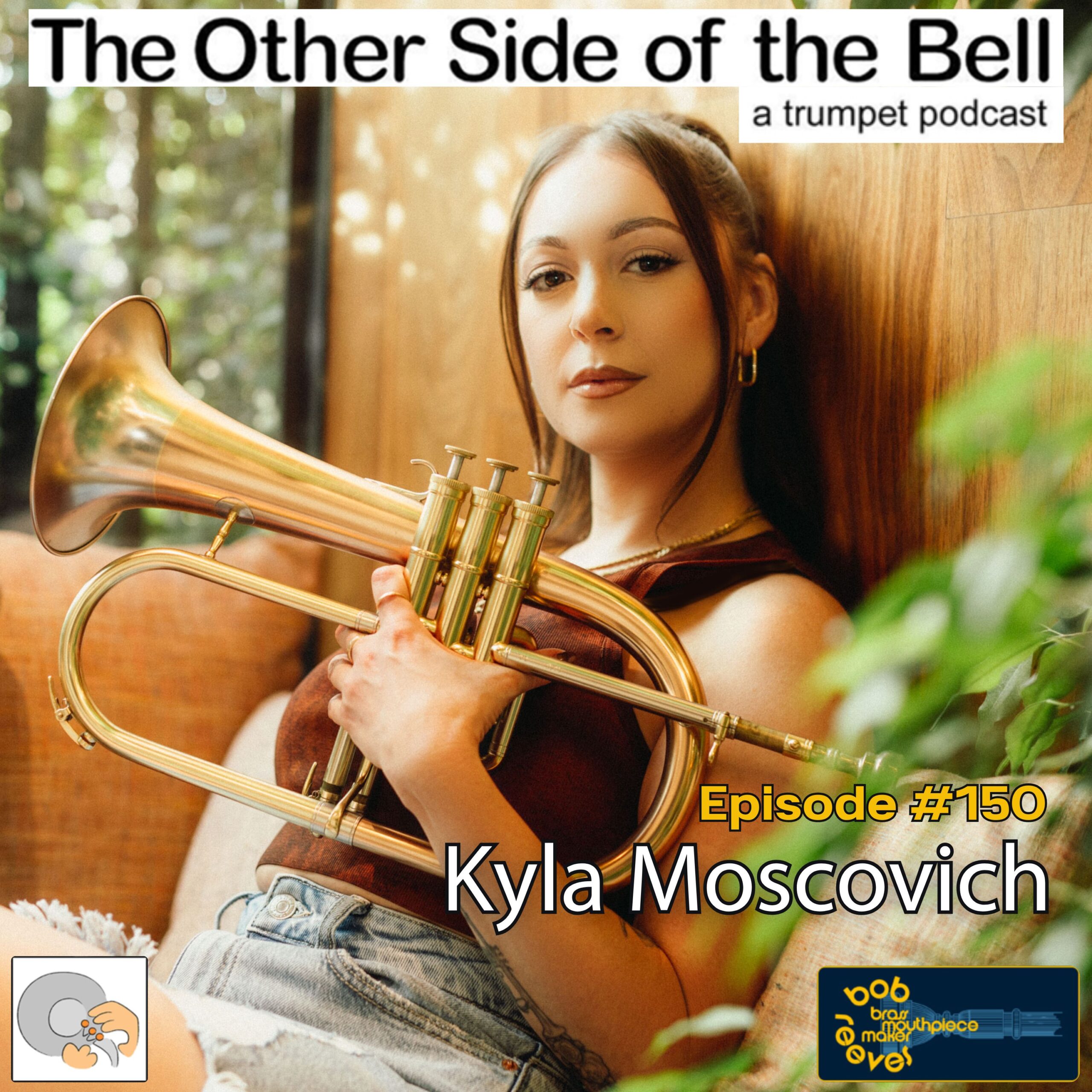
Welcome to the show notes for Episode #151 of The Other Side of the Bell – A Trumpet Podcast. This episode features trumpet performer and recording artist Kyla Moscovich.
Listen to or download the episode below:


About Kyla Moscovich

Kyla Moscovich episode links
Upcoming Bob Reeves Brass Mouthpieces Events
-
Dillon Music, Feb. 26-28, Woodbridge, New Jersey
sales@dillonmusic.com -
National Trumpet Festival, March 20-22, University of Iowa, Iowa City, IA
https://trumpetmouthpiece.com/products/national-trumpet-competition-valve-alignment-special -
Metropolitan Music, April 10-11, Seattle, WA
https://calendly.com/bobreevesbrass/metropolitan-music-valve-alignment-appointment - Arkansas Trumpet Day, April 18th, Arkansas State University, Jonesboro, AR
Podcast Credits
- “A Room with a View“ – composed and performed by Howie Shear
- Audio Engineer – Ted Cragg
- Cover Photo Credit – Courtesy Kyla Moscovich
- Podcast Host – John Snell
Transcript
Please note, this transcript is automatically generated. It may contain spelling and other errors. If you would like to assist us in editing or translating this transcript, please let us know at info@bobreeves.com.
John Snell: Hello and welcome to The Other Side of the Bell, a podcast dedicated to everything trumpet brought to you by Bob Reeves Brass. We’ll help you take your trumpet playing to the next level. I’m John Snell, trumpet specialist here at Bob Reeves Brass, and I’ll be your host for this episode. Joining me today is trumpeter, writer and producer, Kyla Moscovich. We’ll get to Kyla’s interview here in a moment after a word from our sponsor and some trumpet news.
[00:01:00]
JOHN SNELL: Well, I just got back from San Antonio, Texas and another great show in the books. Thank you to everyone who came by the booth, at TMEA, lots of valve alignments, lots of mouthpieces, found happy new homes. A lot of you tried, uh, the great mute selection we [00:02:00] had and found some new homes for the Ullvén mutes and the Charlie Davis mutes and you know, all the stuff we bring.
Oh, and by the way, some of the cool guard bags found new homes as well. always great to see the smiles on your faces when you see some of the cool guard bag designs that we pick up. and also thank you for the podcast listeners that came by. I have a quick shout out to Zacharia. We had a nice chat the other day.
he’s up in the Washington area, band director who found inspiration from the podcast. He’s been listening, I think, uh, almost 10 years now. 2017, I think is when he first found out about the podcast. And some of the episodes, particularly the Tom Stevens and Malcolm McNabb episodes, uh, inspired him, to take his playing to the next level.
And as you know, uh, the band directors out there. You music teachers are in the trenches inspiring future generations and sometimes, uh, your chops can go by the wayside. so, um, was really meaningful conversation and great that Zacharia has, uh, found, more inspiration and joy in [00:03:00] playing, and hopefully brings that back to the students as well that he teaches.
So huge shout out to Zacharia. Hopefully I’ll be seeing Zacharia up at, uh, one of our events in Washington, coming up pretty soon. Coming up, uh, next week I’ll be at Dillon Music long awaited. I think it’s been three or four, three years since our last visit to New Jersey. so many of you have asked when we are, are we going back?
And it’s finally happening. Uh, looking forward to seeing the fabulous staff at Dillon Music, Jim McCombs and Steve and Lynn Dillon and the, uh, all the great, they have such a great store, so much history there and a very dangerous place to visit because. Sometimes I leave spending more money than I make.
Uh, there’s still a few slots available for valve alignments. If you want a valve alignment at Dillon music, sales@dillonmusic.com, send them an email or give them a call, 7 3 2 7 9 5 56 33 and get on the list. As always, my time is limited. I work from when the plane lands to when the [00:04:00] plane takes off.
I’ll try to squeeze in as many consultations and alignments as possible, but make sure, uh, you get one booked. I’ll also have the, 300 some odd trumpet mouth pieces. We’ll have some trombone mouth pieces and horn mouthpiece there as well. And I’m bringing a good selection of old vein mutes.
So if you want to try the dizzy cup or the dizzy bop. Uh, or some of the other great, uh, the, I think I have some stubby bop mutes and also some poppy cup and bop mutes. So if you wanna try some of those out, we will have those available to try and to purchase at Dillon Music. Again, the dates for that February 26th to 28.
Coming up soon, I get a little breather, not much going on early in March, but the, uh, third week of March is the National Trumpet Competition in Iowa City, Iowa at the university. There, the dates for that Friday, March 20th hrough Sunday, March 22nd. that’s the exhibit, at least for the exhibit. I think the, uh, competition goes a little bit before and after, but we [00:05:00] will be there with the whole road show, trumpet, mouthpieces, valve alignments, mutes guard bags, uh, shires trumpets.
I’ll have some Charlie Davis trumpets as, as well at that show. So a lot of great, uh, experiences, a lot of great stuff to try. I do have the link for the NTC alignments, so that’ll be in the description. you can also go to trumpetmouthpiece.com and search up National Trumpet Competition, and the valve alignment pre-order form will show up.
Great way to get your alignment done while you wait and save $25 at the same time. Dates for that again, March 20th to the 22nd. a few weeks after that. I’m going to our good friends at Metropolitan Music. the dates for that April 10th and 11th. I may need a correction. I thought we were gonna be in Seattle.
Metropolitan Music has two stores. One in Seattle and one in Kirkland, Washington. The event will be at the Kirkland Store. Apparently [00:06:00] they’re expecting such a big turnout and the the Kirkland space is larger than their Seattle, space, that they’re gonna have me at the Kirkland Store.
So, if you want to go to that, uh, we’re handling the appointments, for a valve alignments, uh, there’ll be a, a link that you can use an automated calendar system to choose an open slot. The dates for that April 10th and 11th. also it looks like I’ll be staying, an extra day on the 12th.
Uh, the Washington State chapter of the ITG has an event on Sunday, April 12th, and there’ll be a vendor room. So as long as I’m up there in the area, I will, uh, bring all the alignment stuff and the mouthpieces to Bellingham. I think it’s about an hour, an hour and a half north. for that event, I don’t have all the details yet, so you’ll have to stay tuned to a future podcast for that.
So Pacific Northwest, uh, April 10th and 11th at Metropolitan Music in Kirkland, Washington, April 12th in Bellingham at the university There. And last but not least, the [00:07:00] Arkansas trumpet day, April 18th at Arkansas State University, Jonesboro, Arkansas. details still to come on that the final times.
Uh, I don’t have an alignment signup sheet for that yet, but same thing. We’ll have all of the trumpets, all of the mouthpieces and valve alignments there, mutes guard bags. Everything we can ship. Uh, so hope to see you at one of those events. You know, it’s, uh, it’s fun. It’s a little, I’ll be honest, it’s difficult to schlep all that stuff.
Sometimes I wish we made plastic mouthpieces. but you know, it’s always worth it to just to see the look on people’s faces when they actually get to try the models we talk about or do the consultation and really dial in, the equipment to the player. it’s why we do it. It’s a labor of love.
Speaking of which, the Ullvén mutes, you know, as I’ve mentioned before, we were, uh, very, happy to acquire that company last year, and we’re getting production going, you know, ramping it up. I have a few of the Dizzy Cup mutes that came in and a few of the copper, cup mutes, the Dizzy Cup [00:08:00] mute of course, is the, that quintessential sound.
that dizzy used for many, many years. In fact, I just was on a Dizzy Gillespie Facebook fan page, and there was a great photo of him with his adjustable cup mute and his dizzy, bop mute sitting right there, next to him. so let’s see if I can get that and share it. but, uh, they’re, they’re great mutes.
They have that quintessential Dizzy Gillespie bebop sound. They’re kind of hard to come by. I’m hopefully not gonna be hard to come by, as we ramp up production as I’m saying. But, uh, we, I just got a shipment from Sweden. again, they’re all handmade. so those are on the website, trumpet mouthpiece.com.
Just search for Dizzy and that mute will come up if you wanna add one of those to your collection. other than that, that’s all the news I have today. Let’s get right to my interview with Kyla Moscovich.
JOHN SNELL: I am honored to have joining me today, Kyla Moscovich, growing up in New York City. Kyla got her training from the Manhattan School of Music studying orchestral performance and [00:09:00] arranging After graduating, she quickly entered into the studio space where she began writing, recording, and arranging while taking her knowledge of harmony and sound and applying it to her unique musical fingerprint, which can be heard on many world renowned records. Now based in Los Angeles, multi Grammy nominated writer and arranger, Kyla has become one of the most sought after horn producers.
Collaborating with artists such as Jay Cole, Drake, Beyonce, Kanye West Victoria, Monet, Celine Dion, Diana Ross, and more. Now here’s Kyla Moscovich.
JOHN SNELL: I’m so honored to have joining me today on the other side of the bell. Kyla Moscovich. Kyla, great to see you.
KYLA MOSCOVICH: Great to see you too. Thanks so much for having me.
my honor, my pleasure. And excited to talk about trumpet. and let’s start right from the beginning. How did you find the trumpet? Or did the trumpet search you out
That’s all. Thanks to my dad. Honestly, I gotta give him credit where it’s [00:10:00] due. there was always trumpets laying around the house. Um, my dad always played for fun and has always been a big trumpet fanatic, so I just landed with one in my hand at a very young age. And here we are 33
JOHN SNELL: young. Like how, how, how, I mean, how young I, I kind of know. ’cause I mean, full disclosure, you and, uh, your dad, and Bob Reeves were close friends, so,
KYLA MOSCOVICH: I’d say like a year old, even younger. Yeah.
JOHN SNELL: before you could walk, you had a trumpet in your hands. You’re messing around. Messing around
KYLA MOSCOVICH: Mm-hmm.
JOHN SNELL: Wow. And so your dad, I mean your dad was a veterinarian, but he, did he play, he played,
KYLA MOSCOVICH: Always played for fun.
JOHN SNELL: Uhhuh
KYLA MOSCOVICH: he always was a big music fanatic and still is. And so I was always exposed to really great music At a young age.
JOHN SNELL: and it was in New York. Right.
KYLA MOSCOVICH: Yeah.
JOHN SNELL: quite the place to find literally the best music in the world as, uh, any, every corner you turn. so what did your, the, the first years look like? Was he, would he try to teach you or did he just kinda let you [00:11:00] experiment on the horn?
KYLA MOSCOVICH: a little bit of both. I mean, I think he really started teaching me or helping me, uh, in a guidance sort of way when I really showed interest in it. but before that it was just exposure. and he kind of just let me do my own thing and we are.
JOHN SNELL: Yeah. So what, what, like, what kind of thing was it? Uh, jazz, classical, orchestra, everything.
KYLA MOSCOVICH: Yeah. just a lot of the music that they exposed me to when I was younger was a lot of classical music, a lot of jazz, um, some funk stuff, uh, here and there, but a lot of straight ahead jazz and, and classical,
JOHN SNELL: Any anyone in particular you remember listening to?
KYLA MOSCOVICH: yeah, a lot of Clifford Brown, Freddie Hubbard, um, a lot of Louis Armstrong. a lot of Stravinsky, Desy, rale, um, Mahler, a lot of those composers that were big orchestral, [00:12:00] brass fanatics and would orchestrate really cool stuff for brass sections.
JOHN SNELL: The good stuff, as I like to
KYLA MOSCOVICH: Yeah. Oh yeah.
JOHN SNELL: The good stuff. The, and we’re talking about elementary school, right? I mean, to put this in perspective, you’re listening to these
KYLA MOSCOVICH: beforehand, know, as an infant, um, I just remember growing up in a household full of music.
JOHN SNELL: surrounded by it. Oh, and I, it’s amazing. And it’s how important it is. So you’re, you surroundings even at a, at an early age. So, so when did you, I say get serious, but when did you really kind of start taking a liking to the trumpet?
KYLA MOSCOVICH: I would say I remember really taking it seriously in about fourth grade.
Um, and that’s when my parents realized that there was a talent there that should be honed in on and given some attention. So they put me in. You know, different lessons with different teachers trying to kind of find what worked best for me.
I started, learning ear training [00:13:00] in, in New York City with a accompanist for the New York fill named Mic Morikawa, who I’m still really close with. and my ear has been a very important part of kind of how I’ve built my, career
JOHN SNELL: And that, and, and that started in fourth grade, fourth,
KYLA MOSCOVICH: I would say about, yeah, about fourth, fifth grade. Um, and my dad made a very good decision to put me in lessons with a trumpet player named Vince Penza, who took me on when I was super young and realized that I had a very good ear and Mechi actually lived in the same building as him. Um, a couple floors down, I believe.
And so he was like, look, if you’re gonna be taking lessons with me, I wanna hone in on one of your strengths, which is your ear, and I want you to get that trained properly. So getting into a structured lesson [00:14:00] situation with Mechi would be the best for you. And that was one of the best things that really ever happened in my career.
Yeah.
JOHN SNELL: Incredible. So I mean, we were talking about like souled
KYLA MOSCOVICH: Yeah. A lot of stuff I know, a lot of sight reading. Um, and so it’s still one of my favorite things and helps me out a lot in the industry that I’m in.
JOHN SNELL: incredible, and what I mean a shout out to your parents for getting you involved in that at and giving you those tools at such a young age.
KYLA MOSCOVICH: I know I didn’t always appreciate it. Um, but now in my thirties, I, I definitely do.
JOHN SNELL: It comes back, right?
KYLA MOSCOVICH: Oh, absolutely.
JOHN SNELL: I was just having that conversation the other day. Uh, and parents, but also teachers too, you know? Uh, you know, when my, my trumpet teacher told me this when I was 18 and I just, you know, all of a sudden in my forties it makes sense, you know, like I didn’t get it then I probably fought it at the same, you know, then and now all of a sudden it clicks, you
KYLA MOSCOVICH: Oh yeah. I was a spicy little kid, so there were definitely times that I’m sure [00:15:00] my parents can tell you. Like, I just, there were moments when I just wanted to be like a normal kid and like go out and play and my dad was like, well, you have to practice. You have to, you know,
kind of be a bit of an adult at the same time.
JOHN SNELL: kind of funnel you as best he could. So it was, so speaking of practicing, so what did that look at, uh, look like? Uh, uh, is it something you enjoyed doing, that you go home and No. Really?
KYLA MOSCOVICH: no, I did not enjoy practicing at a young age. Um, my parents were really strict about that.
JOHN SNELL: So they literally had, they had to make you practice. It wasn’t something you were excited to get home from school and
KYLA MOSCOVICH: no. Oh God.
JOHN SNELL: outta the case.
KYLA MOSCOVICH: No. and I know that, you know, it was my parents’ first time on this planet as well, so they were just doing their best and doing the best that they could. But there were so many moments when I was like, I just wanna go to this birthday party, or like, I just want to go and hang out with my friends after school.
But it was mandatory that immediately coming home from school, I had to practice like an hour, two hours, something like that, and, [00:16:00] and really hone in on, on my craft and not focus too much on really being a kid. And there were times when I really resented the jump into adulthood really quickly on, but now I, I, I do appreciate some aspects of it.
there were parts about it that were really difficult.
JOHN SNELL: Yeah. Yeah. Well, and I appreciate your honesty too because, you know, growing up and especially being gifted, talented, whatever, I hate using those words ’cause, you know, we all have to work hard. Some people are good at some things, some, uh, you know, struggle at others. but you took to the trumpet fairly quickly.
was there a point when you said, I wanna do this the rest of my life? Or was it a thing that you just, you know, happened to be good at that, you know, you were going along this path?
KYLA MOSCOVICH: a lot of, if I’m being completely honest, it was a lot of, this is what I’m good at, so I’m gonna go down this path. But I found a way later on to kind of incorporate [00:17:00] my idea of what this meant for myself into the vision that my parents had built for me, on their own.
Which is really what led me from starting in the classical realm and the jazz realm to kind of going into the mainstream, billboard Top 100 world.
JOHN SNELL: That you are now. Yeah, that’s, and I, I want to get to that path ’cause it’s, uh, I mean it’s really interesting following your career, from partly the other side of the coast and now on the same coast. Uh, but I, I wanna spend some time on, on Mr. Zoella. ’cause I mean, Bob had the utmost respect for Vince as a, uh, you know, as a teacher and I know did a lot of work with him.
And one of my regrets is when I first started working here 25 years ago, you gotta go fly to New York and get a, you know, lesson with Penza Rella. And, you know, I, I never did I regret doing it. you know, and I have a million excuses why I didn’t go to New York. so I’m curious what your experience was, with him and also the fact that, uh, you were quite young.
I mean, he didn’t take very many, if any, [00:18:00] students Right. Of, uh, in
KYLA MOSCOVICH: didn’t.
JOHN SNELL: school.
KYLA MOSCOVICH: Yeah. I was his only like young student. he really became a huge mentor for me at a young age. and he could tell that I was really doing things in my own way, but also he’s a girl dad, so he, I think, saw something in me that was very much, something he wanted to, help guide and like he wanted to help nurture and, and.
I’m just super grateful that he kind of laid the, the stones for the path that I ended up following.
JOHN SNELL: That’s amazing. How, how did he do that? Like, was it,
KYLA MOSCOVICH: So my memory is super wishy-washy on it. ’cause I was so, I was so young, but I remember it started with weekly lessons when I was, I believe in middle school and [00:19:00] we would go to his apartment in New York City and I, I remember he always had this, doormat that said, go away. He was, he’s such a sassy guy.
Like he, he always had the funniest, um, he would make me laugh. He had the funniest sense of humor. super Italian, New York like. Demeanor, uh, super strict, super strict, but also found the balance of working with me when I was a child and still found that balance of fun, but also, you know, structured.
JOHN SNELL: Mm-hmm.
and yeah, he always, I think what he really honed in on was my ear and my tone. He was a big, sound oriented person, so of course we worked on technique and all that other stuff, but we really focused on developing my sound and how to get it to be big and natural and kind of just an extension of my human voice,
JOHN SNELL: Hmm.
KYLA MOSCOVICH: which I thought was a [00:20:00] great thing to, to
hone in on.
JOHN SNELL: working on that. Yeah. At such a, at such a young, and what, like what did that look like? Was that through, I mean, I’m assuming he’s doing the fundamentals with you, Arbin and Clarks and things like that. was there anything specific you remember about developing your sound?
KYLA MOSCOVICH: Oh yeah. a lot of it was, he’s very big on sing everything before you play it. If you can’t sing it, you can’t play it because it means you’re not able to hear it properly, mentally. And so a lot of soja work, a lot of singing, which meant developing my human voice in order to better develop the sound that came out of the horn.
but yeah, he spent a lot of time singing with me and getting me to Gio, even the hardest, you know, b Etudes in like middle school, which are super atonal and insane. But he would, he just had me doing the craziest stuff and never put a limit [00:21:00] on how far I could go.
JOHN SNELL: Mm-hmm.
KYLA MOSCOVICH: Which was fantastic. so
JOHN SNELL: that’s in Incredible. So, he played with New York, Phil. Right. So he primarily classical training. Were you also working on jazz and other idioms at the same? Nope. Purely.
KYLA MOSCOVICH: classical. I remember when he found out that I was doing stuff other than classical, he was kind of like, Hmm, okay. Like, all right.
JOHN SNELL: The devil’s music, what are you doing?
KYLA MOSCOVICH: kind of. But he never really, he never disliked jazz or disliked any other genres, but he was a big, uh, classical orchestral guy, so that was his thing. But he would always throw these parties at his house with all his like, college students and, people in the orchestra that he would play with.
And I remember going to those parties at such a young age and my dad would bring me. He would make me play in front of all these people. And he was a good hang.
JOHN SNELL: Yeah. What fun. What fun. So, uh, you studied with him [00:22:00] all the way up through college
KYLA MOSCOVICH: Yeah. All the way up through college.
JOHN SNELL: amazing. And, when you were going to school, were you playing in like the school bands and things like that as well, or
KYLA MOSCOVICH: So that’s also a really funny part of kind of my college education and my college experience. so I was a classical major and Manhattan School music didn’t allow genre bending or any like cross major type stuff. Um, so if you were a classical major, you were in orchestra, you were in your small ensembles, you were taking your lessons, and then the rest of the time you were in the practice room shedding excerpts.
That was it. Or like preparing for juries. but I had gone to, I got, I went through a few chop changes, um, unfortunately during my, I think it was my freshman or so sophomore year. And, I ended up switching over [00:23:00] from Penza because he got super busy. He was traveling to, to Italy to his other estate and all this, this stuff.
So I felt like I needed a bit more hands-on work and I ended up getting like a dual, uh, teacher situation with Mark Gould. And Mark saw that I was super interested in other genres. And because you can’t study with anybody from the jazz department, he just didn’t tell the school and put me in lessons with Lori Frank. So I would have two lessons a week and I would have Lori one day and Gould another day. Mm-hmm.
JOHN SNELL: Let’s do it.
KYLA MOSCOVICH: And I consider that to be, one of the things that I’m so lucky to have experienced was time with Lori Frank, and she was the one that was like, Hey, I see [00:24:00] more than just classical music in you. ’cause she knew about the classical world.
She was able to go through excerpts, help me with my jury stuff, help me with all the classical stuff. But she also saw that I was interested in other things. So did Mark. one of the best things that Lori ever did for me was hand me a microphone, an amp, and a line six. And she was like, just go have fun with sound.
Don’t even focus on excerpts right now. You’ve already done your jury. You’ve already done whatever. You nailed it. You did great. Go have fun.
JOHN SNELL: Wow.
KYLA MOSCOVICH: So that is what kind of got me experimenting with sound and kind of bridging the gap between the jazz world. And then that’s what allowed me to, I spoke to Mark Gould and I would kind of sneak in and listen to some of the other jazz ensembles, I don’t even know how they allowed this to happen, but I was able to participate in a jazz combo and the Afro-Cuban Latin jazz band at the school and a couple of other ensembles, [00:25:00] uh, which I, I definitely wasn’t allowed to do.
JOHN SNELL: Breaking the rules. I love it. I, I mean, what, what an amazing story about Lori too. I, we’ve had a few of her other students on, you know, the podcast before and, you know, I think they’ve all owed their careers in some form or another to, to Lori. Um,
KYLA MOSCOVICH: studied with her was very lucky.
JOHN SNELL: yeah. And, uh, I mean obviously that was a great example. What about, was there some things like plane wise she, she worked on with you or, um, can you get into that a little bit? Yeah,
KYLA MOSCOVICH: everything. she worked on how to make the horn a lot easier, uh, on me and how to not put so much effort into getting the horn to sound the way I wanted it to sound. but a lot of the work that we did specifically was mental work, um, which is something that I needed a lot of. Uh, especially having started young and [00:26:00] having had a specific, like, you know, very militant way of thinking about the horn.
And what I love most about Lori is not one person had the same experience learning with her. Everybody’s experience was different. So she basically made a tailored, a tailored suit of, a curriculum for each person that came in and out of her studio.
JOHN SNELL: Hmm.
KYLA MOSCOVICH: So my lesson plan was not even remotely close to the next person’s lesson plan.
And that was a really interesting thing. After she passed, a lot of her students got in contact with one another just to compare, like, what were your lessons like? And we all realized, we were like, oh my gosh, we didn’t just stick to like a certain way of teaching people. Everyone had different situations.
JOHN SNELL: She had that gift to know what the, what the student needed that was sitting in her, in her studio. Amazing. was it difficult studying with her and Mark at the same time, like getting different directions or different or
KYLA MOSCOVICH: I, I [00:27:00] think I just was learning very different things from both of them and, but both methods were, necessary to kind of develop me in my playing and where I kind of ended up,
JOHN SNELL: what were some of the things that Mark worked with you on?
KYLA MOSCOVICH: a lot of the classical stuff, a lot of the, excerpt stuff, learning repertoire, and also just certain techniques on how to play these excerpts with ease and musicality. so it didn’t kind of just sound like a robot, which I feel like a lot of, younger trumpet players kind of. it lost the emotion in their playing, kind of sticking to these excerpts over and over again.
They were trying to play like a specific person rather than like embodying their personality within these excerpts. So they created their own sound.
JOHN SNELL: Fascinating.
KYLA MOSCOVICH: yeah.
JOHN SNELL: Amazing. What, what an [00:28:00] experience and to put this into context, like you had already had success by this point, like solo wise, right? Hadn’t you like won competitions and I, things like that. I, and I remember, correct. Correct me if I’m wrong. I think I, I remember seeing like a YouTube video of you with Fattest playing on stage or something
KYLA MOSCOVICH: yeah. He’s another one who’s been a big mentor for me.
JOHN SNELL: and how did that come about?
That was like one of the first viral, not to put you on the spot, like it had have been one of the first viral YouTube trumpet videos. Was you getting pulled on stage with fattest playing a blues or something like that.
KYLA MOSCOVICH: Yeah, so I met fads, I believe, at the International Trumpet Guild competition when I was in middle school. And, you know, I don’t, have you ever been to the ITGs or NTC
JOHN SNELL: Oh yeah. To many.
KYLA MOSCOVICH: yeah, so they have the, very much like Nam, they have the big booths with like all of the vendors and like cases and mouthpieces and just all this [00:29:00] gear.
And so we had gone up to the showrooms on one of the days and there was this guard bag that I was, I had like fallen in love with and I was like, oh my God. Like, this is so cool. It has a freaking compass on it. It has like, you know,
just like I was a kid, I didn’t know. I was like, oh, it rolls. It’s like a.
Suitcase type deal. Oh my gosh, I want it. And I showed it to my dad and my dad was like, no, put it back. We’re not getting it. And I was like, oh, please. And he is like, no, sorry kid. We’re put it back. We can’t afford that. We’re not getting it. I guess in the other, on the other side of the room, I guess Fatus had seen that and he went, bought the case and then just came up to me and he’s like, is this the one that you wanted?
And he’s like, it’s all yours, you can have it. And I was like, oh my gosh. So I ran over to my dad and I was like, dad, dad, this man bought me a case. And my dad [00:30:00] was like, what do you mean this man bought you this case? Go put it back. And I was like, no, I’m not lying. This guy got me this case. And my dad’s like, who?
And he goes over, my dad knows who Fats is because he’s a trumpet fanatic. And he’s like, oh my gosh. He was like, no, you don’t have to do that. And John was like, no, please it, it’s my pleasure. I would like to gift this to her. And that is what started a long friendship. We found out that he was teaching at SUNY purchase, which was super close to where we live.
And so we stayed in contact and he would, on days after he was done teaching, he would just drive over to our, our house and hang out with me and listen to records. And we would just do a lot of mental transcriptions and listen to solos. He would just kind of broaden my, ear on different things.
Like a lot of Louis Armstrong, a lot of, [00:31:00] different artists and would. Just, I just remember sitting on the floor and like playing record after record and he would just talk to me about the history of each record and why it’s so important in, you know, what we listen to now and this and that. And then that led to him inviting me places.
so he would be like, you know, why don’t we, I have a show at Blue Note, or I have a show here. I have a show at this spot I would like for you to come and sit in. And so he just kind of exposed me to a lot. And then he actually gave me my first gig, which was, yeah, I was in middle school and I was, I remember ’cause I was studying for my, I think it was my midterm exam.
And the rule was you get to be on the gig as long as you bring your flashcards and study during break. And so he would make me study my flashcards and he would quiz me and all that. [00:32:00] And so we were playing at the Louis Armstrong house. It was a week long gig, I believe, or like a couple days long. And it was with Antonio Hart, and all these other great musicians.
And yeah, he paid me the same amount as everybody else.
JOHN SNELL: Amazing. But he made sure you’ve studied
KYLA MOSCOVICH: Yes. Oh yeah. that sounds like John,
Yeah.
JOHN SNELL: his last time he was here in the shop. I, I was, uh, I had both of my boys here, um, and I forgot how old they were. Like one was still in a high chair, so he must have been like one, one and a half
still a baby. And then my, my older son was the same age as his daughter. And I mean, yeah, John, I mean he loves us and he loves Bob, but you know, he wanted nothing to do with us and trumpet.
He wanted to play with the kids.
KYLA MOSCOVICH: Oh yeah.
JOHN SNELL: So he, you know, he was sitting down at Bob’s desk watching, uh, some PBS show with my older son and he is playing, playing along for my baby, sitting in the back in the high chair. And I mean, what a generous soul. And, and to give you that kind of [00:33:00] experience like, and that kind of inspiration, at such a young age is absolutely amazing.
And,
KYLA MOSCOVICH: yeah,
JOHN SNELL: but
do your flashcards.
KYLA MOSCOVICH: Right. But don’t get me wrong, seeing him work with older students of his, I remember one time he, he was like, why don’t you come to Sun SUNY purchase and listen to a rehearsal we have with the combo, one of the combos that I teach. And I was like, super excited. So I went, I listened. Oh my gosh.
I was like, I got to see a different side of him that I was shocked. I was like, oh my gosh. He doesn’t speak to me like that. That’s crazy. He’s strict.
JOHN SNELL: Strict, demanding, but, but fair. You know? Like he knows, he knows what you need to do. And, and also the honoring of the, the history and the legacy, you know, that jazz musicians come out of, what an experience. So, so like, go, getting back to when you were in, uh, university, like where was your career going at that point?
Like, were you being pulled in different directions or did you have some kind of inspiration of where, which direction you wanted to go?
KYLA MOSCOVICH: [00:34:00] I think during my undergrad it was still very like the, I was sticking to the plan. The plan was take auditions or prepare for auditions, take auditions, land a gig in an orchestra, keep that, get tenure and stay there forever. That was the plan. but I think a couple, there were a couple times when I had conversations with Mark Gould and Lori Frank, who were the first two to be like, Hey, you know, there are other options other than just that.
And I was like, well, I don’t, I don’t understand how I could end up there if my training has only really been on this route. And so I think university was really where I discovered that, uh, possibility for myself. And so I started going out and listening to other genres of music. I would go to hip hop events and, you know, random rap battles that were happening in New York City, [00:35:00] uh, freestyle Jams and DJ sets and all this other stuff.
And just meeting different pockets of people, which I, I think was super helpful to kind of broadening my vision of what my career could be for myself.
JOHN SNELL: Interesting. And I, uh, I mean, did you, listen, this may seem like a stupid question, but like, I know you were surrounded by big band and jazz and classical music growing up was, you know, I mean, did you have a typical teenage like music experience listening to, the pop songs of the day and the hits and the cheesy music and stuff?
Or were you just in immersed in trumpet?
KYLA MOSCOVICH: Yeah, I was just really immersed in trumpet.
JOHN SNELL: So this is kind of your first then foray into. F those idioms.
KYLA MOSCOVICH: Yeah.
JOHN SNELL: Wow. Did you get the bug? I mean,
KYLA MOSCOVICH: I mean, apparently,
JOHN SNELL: that’s the dumb question because of where you’re at, but so what was that, what did, what did that path look like then? I mean, how did you just explore that further?
KYLA MOSCOVICH: yeah, I ended up. Going to [00:36:00] random jams and sessions that were happening in New York. And I landed at this one space called Arlene’s Grocery. Um, I think it was Thursday nights. they had a hip hop, like underground hip hop type of session. And there was a small horn section at the time that let me sit in.
And I ended up gaining traction there and met a lot of artists that I still work with now and still hang out with now. And so that kind of just broadened my ear, but I, I got to be in close proximity with some people that really helped broaden my ear. And since my ear was so strong, that was really how I learned.
so I got to. Stand next to some of the dopest musicians in the game who, you know, I watched Keys players and how they kind of operated and these settings. And ultimately I think the biggest thing I [00:37:00] learned in that setting was how to listen and not play first.
JOHN SNELL: Hmm.
KYLA MOSCOVICH: So learning how to communicate mentally, by listening to what the drummer was doing and how to communicate in a setting on stage without any words, just listening to one another, understanding the musical intuition of being in a setting like that.
ultimately that led me to church and playing in church, also helped broaden my ear and understanding. So I just exposed myself to a lot of different things.
JOHN SNELL: And, uh, freelance wise, were you still taking classical gigs, jazz gigs, things like that?
KYLA MOSCOVICH: I think by then I had kind of gotten fed up and had enough.
JOHN SNELL: Really,
KYLA MOSCOVICH: Yeah, I
JOHN SNELL: No more excerpts. It’s.
KYLA MOSCOVICH: I, you know, I would do certain shows and certain gigs, like if somebody wanted me to play a solo with this, quintet or a group or some sort of thing like that, cool. I [00:38:00] would do that. Or, you know, the typical Easter gigs playing trumpet and piccolo in a church.
Cool. those are always big money gigs on Christmas and Easter. but aside from that, I was just having fun exploring and really getting out there. I even remember telling my parents these things like, Hey, I have a, I’m playing a, a residency at this place at the Groove in New York City. And, they’d be like, playing what?
And I’d kind of explain to them, and I think they came like once or twice maybe, but I had that residency for like four years.
JOHN SNELL: Not their cup of tea.
KYLA MOSCOVICH: No, I think they were just a bit confused by like what I was actually doing.
JOHN SNELL: Yeah.
KYLA MOSCOVICH: But I mean, so was I at the time. Let’s be real.
JOHN SNELL: Yeah. So when, I mean, was there a point when you started realizing what you’re doing or getting that clarity?
KYLA MOSCOVICH: I mean, I think, I’m still trying to figure that out if I’m being [00:39:00] completely honest. Every day is so different. You meet different people, you get exposed to different things, you. have different experiences. I think it’s just a matter of not blocking myself from experiencing those and staying so strict to like a specific idea of what I’m supposed to be doing,
you know?
JOHN SNELL: But it, it was during that period where you started doing like the writing Right. As well and, and producing.
KYLA MOSCOVICH: yeah,
JOHN SNELL: So jumping on the other side of the microphone or
KYLA MOSCOVICH: yeah. I always sang and I always, was very big on balancing the vocals with the trumpet thing, but, I think it became more relevant and prominent when I left college and really started just experimenting with sound in different, um, in different ways. And then I started getting into studio life and realizing what that was like and.
Getting opportunities to write with different people and create with different people in a different [00:40:00] form. And a lot of the people I met at Arlene’s Grocery, that event was called The Lesson by the way, and I would create with those guys in different, uh, capacities. And it was just a whole mumbo jumbo of just random experiences that gave me the ability to learn from those and, and take each bit of, you know, little pieces of it and kind of put it in my back pocket as I kind of traveled through my path.
JOHN SNELL: Yeah. so you’re doing some recording, doing some writing, doing some producing. Did you ever do any touring at this point, or, was it all local? Was.
KYLA MOSCOVICH: yeah, I was doing some touring. mostly like one-offs or like small short tours. But I really started touring in, I think it was 2014, 15, like right when I got out of college. I landed a tour with Macklemore and I toured with him for like 11 years, 12 years. It was pretty crazy.
JOHN SNELL: [00:41:00] That’s a, that’s a long stint in, uh, pop music world, you know, especially as a horn player too, you know, we’re usually the first to go. well, so was that your first kinda, like, major artist that you had worked with or
KYLA MOSCOVICH: No,
I had worked with a bunch of major artists, uh, before that, but he’s, I think, the longest standing one that I had, the longest working relationship with.
JOHN SNELL: Who, who, who was the first kind of, I mean, I know you, the people you were doing the residencies and stuff where, you know, you guys all worked your way up into the business. but whether there’s a point, like you got a call from an artist, you’re like, oh, this is another level.
KYLA MOSCOVICH: Yeah, I think one of the first was really Jay Cole.
he was really one of the first major artists that I had the privilege of working with and man, I’m trying to go back in time and like remember all this stuff. all a mumbo jumbo of
JOHN SNELL: Ancient, ancient history.
KYLA MOSCOVICH: yeah,
JOHN SNELL: It’s like, like when I interviewed Doc Severson, I was like, oh, back in 1939, you know,
KYLA MOSCOVICH: [00:42:00] But his memory is crazy.
JOHN SNELL: yeah, I don’t even remember what I had for breakfast. And he is talking about the trumpet section in, uh, you know, Tommy Dorsey’s band or something. Um, so I mean, do you remember how you got connected with j Cole?
Was it just through your connections that, that you were doing the residencies with?
KYLA MOSCOVICH: Yeah, it was just, I, a buddy of mine that I had met in the jazz scene in, in New York, he randomly called me one night, he’s like, Hey, what are you doing right now? And I was like, I am sitting at home just hanging. And he was like, well, if you’re not busy, they need a horn player. They need a trumpet player to go down to Electric Lady and work on this album.
And I was like, okay, I trust you, homie. And then I went, and that turned out to be the Four Your Eyes Only album
by j Cole.
JOHN SNELL: Man.
KYLA MOSCOVICH: And that’s how it began. I think it was one of the first major studio moments for me where I was like, oh, [00:43:00] I like this. This is fun.
JOHN SNELL: yeah, there was a buzz there. I mean, did that kind of springboard you at that point then, like, the recognition from being on such a high profile album?
KYLA MOSCOVICH: Yeah, it definitely did. It definitely did. and it just kind of snowballed from there, which was really cool.
JOHN SNELL: so I, I like to think that music schools these days are doing a better job at kind of the reality of a working musician’s life. You know, that we do play more than one genre and we do have to go on tour or go in the studio, things like that. what were some of the things like for example, on Jay Cole’s album or some of the later, uh, studio or touring stuff you did that you had to kinda learn on, on the job that, uh, school didn’t really prepare you for?
KYLA MOSCOVICH: everything new age, so I was on the, the cusp of like. Using computer. Like we didn’t use computers at Manhattan School of Music. It was all manuscript paper, it was all [00:44:00] analog.
So anything digital or using a computer or electronics or microphones or recording or using an interface, I didn’t learn a single bit of that in school.
I didn’t even know how to use a computer. If I needed to use one, I would go to the library. but yeah, it, all of it, I was exposed to all of it after school where understanding what mics were suitable for my specific sound, how I wanted to sound and how to emulate that sound and get it to sound a specific way.
how to find my specific fingerprint in like. What makes me sound different than other people, especially in a recording setting, how to use pro tools, um, or any daws of any sort. all of it, you know, understanding what a talk back microphone was and how to, how to use that and how to, all of it, even just etiquette in the studio.
[00:45:00] I, um, I’m just glad I was a very observant person and was able to listen and understand and not just jump in and go
JOHN SNELL: And Yeah, learn, learn along the way. Right. And, and just, so just because we have a lot of international listeners as well, and most of ’em are probably younger than me and know what a das is, but that’s, it’s a di digital audio what Works workstation. Right. And, and that’s, um, that’s what they use for like live concerts and stuff.
Right. To that program or, or production. Yeah.
KYLA MOSCOVICH: Yeah. So Ableton Logic Pro Tools, all the All the things.
JOHN SNELL: Um, and I have to ask, so was the MIC and the amp that, uh, Lori Frank gave you, did you actually experiment with that? And was that helpful that, that got you along the way?
KYLA MOSCOVICH: Well, she gave me like a looping station. I was able to make like random cool stuff. I was able to mess around with reverb and see what that was like, and just experiment with sound and not really focus on perfection,
JOHN SNELL: So you had, [00:46:00] you, you had some, uh, some experience. It’s just thanks to that you weren’t, you weren’t starting at zero. Amazing. So, so Macklemore, I mean, I was a huge fan of Macklemore. Um, what, what was that like when you got that call and now you’re going out on a, I mean, those were like major world tours, right?
KYLA MOSCOVICH: Yeah, they were
super fun. Yeah, I was really privileged to see and explore the world in that capacity was such a great artist. and I’m, we’re still very close and he, yeah, he’s addicted to touring in the greatest way possible. So we had a lot of opportunities to travel the world and play on some of the biggest stages, and that was also another learning environment for me that I got to really expand on.
but what I really appreciate about Macklemore is he allows you to really be yourself on stage and. He doesn’t want you to just, you know, sidestep and just look cute that that’s not him at all. He wants it to be a whole [00:47:00] fun experience. So the show is very cardio based. Like you’re running around, you’re doing a lot of, of choreography, you’re singing, you’re doing all this fun stuff.
So I got some pretty fun experiences.
JOHN SNELL: How cool was it? Uh, I mean, had you done any big shows before that, you know, stadiums and the like, or was
KYLA MOSCOVICH: Yeah, I had, but not while living on a tour bus or while flying every day or every other day, or you know, not going home for long periods of time. There was a definite learning curve with that lifestyle that I think I was privileged enough to be in an environment where learning that was allowed and.
Appreciated and understood. So I, there was wiggle room to really figure that out for myself.
JOHN SNELL: And that your crew was great, and I mean, that was a big production, right? I mean, how many, how many people toured
KYLA MOSCOVICH: [00:48:00] Well, there were three buses. You know, you have the artist bus, the crew bus, the band bus. I’m sure there were more that I’m just forgetting about, but it, yeah, it was a very large crew is a very large crew and he just likes to have fun. He’s like a little kid. He always, he, he really, he’s inspired me in a lot of ways and I’m just really privileged to have worked with him for that long and to still have that relationship.
JOHN SNELL: Amazing. And I mean, were you able to do other projects while you were touring? Were you doing any other recording or were you still based outta New York then, or had you come out to LA
KYLA MOSCOVICH: So I was still based in New
JOHN SNELL: Okay.
KYLA MOSCOVICH: during that time. And yeah. What I loved about Macklemore and still do is there was never like a closed contract or an exclusivity contract where you have to work solely on Macklemore’s stuff when you’re on the road with Macklemore. So like I would bring my little travel studio with [00:49:00] me and write on the road and work for other artists on the road.
And even on off days, I would book studios and random cities and random places around the world, which also allowed me to meet some really cool people and connect with studio owners and different corners and pockets of the world. So then if I ever went back, I would go and, or I can recommend the studio to other people who might be looking for a studio while they’re on tour.
Just fun stuff like that.
JOHN SNELL: And, and this is all independent. I mean, all of your production was people that were hiring you because they knew about you, wasn’t part of a company or
KYLA MOSCOVICH: I think that’s something that’s been really cool for me in, in my career is I’ve, one, I’ve gotten myself here 100% by myself, um, of course with the help of my parents in the beginning, but in terms of making my connections and keeping those relationships and building on those relationships to help nurture them, that was, something I did completely [00:50:00] by myself.
And so everything was word of mouth and recommendation from either something they had heard me do previously or, you know, seeing me live. One of the two
JOHN SNELL: Yeah. Incredible. And, and the skillset that goes along with running your own, I mean, you’re a one person small business. Um.
KYLA MOSCOVICH: started. It got to a point where it was so overwhelming and I was like, I have to remind myself daily that I chose this life. This was a, a cognitive choice, like a, I made this decision.
JOHN SNELL: You could be sitting in an orchestra somewhere, you know, because
you show up on this time and that day, and then you go home, you know?
KYLA MOSCOVICH: right. And a lot of people, even still, they don’t understand that like, hey, the trumpet is a monophonic instrument. In order to record like a larger scale arrangement, it’s not gonna take me 25 minutes like it would to create a small arrangement on a piano or a [00:51:00] workstation. It’s gonna take some time.
’cause you gotta stack things out. You gotta record things properly and it needs to be panned properly. It’s like, it’s a whole process. So there’s still moments when I’m like, Hey, just a reminder. I’m just one little lady. Like, be patient with me.
JOHN SNELL: I need this yesterday. Come on.
KYLA MOSCOVICH: Oh, you’d so surprised.
JOHN SNELL: uh. It, I mean it, how was the, the, the trumpet through all of this? I mean, did you keep up a regular routine with the touring and, you know, or did it kind of take a
KYLA MOSCOVICH: What do you mean? Like practicing routine? No, it’s impossible. It’s, at least for me, it was physically impossible. I always warmed up before I played, I always warmed down after a show. but in terms of scheduling time to practice, it’s always really difficult. You know, you’re staying in hotels, there’s noise restrictions there.
You know, I would sometimes practice in a [00:52:00] hotel room if I felt very inspired, but most of the time you’re sleeping or you’re out getting some fresh air, and you’re given your chops a break. But it was really, that was determined by what the, the tour schedule was predominantly. And then, not to mention when you’re living on a tour bus.
Forget about No one wants to hear you practice,
No.
JOHN SNELL: even in a practice mute, uh, you
KYLA MOSCOVICH: Correct. And so when that’s the case, I’ll typically at the venue find places to hide away and practice for a little bit or just keep my chops up to shape. But there’s, you know, in Macklemore show, there’s so much playing that my chops were always in such great shape by the end of a tour.
JOHN SNELL: Road chops. So, yeah. So you didn’t, you didn’t get yourself turned around, which I know is unfortunately common, especially going on the road for that long and that extensively. So, you must have had good fundamentals. Someone set you up. Right?
KYLA MOSCOVICH: Yeah. Somebody set me up. Right.[00:53:00]
JOHN SNELL: Um, so, so what, what brought the move to la.
KYLA MOSCOVICH: I think after. Doing j Cole’s album, I realized how much fun I had in the studio. And New York is phenomenal for live stuff and getting your live chops up and learning how to communicate with people and how to interact with people and how to foster good relationships and hustle. But I think realizing that I wanted to be more in studios and also I was getting flown out to LA for certain studio opportunities and I was like, you know what?
I’ve been in New York my whole life. Let me, let me just try something new for a little bit. So I got back from a tour, I’m just decided to try it out. Bought a one-way ticket and landed a gig really quickly into that and also got, um, the opportunity to be a part of a really cool writing camp. As soon as I landed in [00:54:00] LA I had reached out to a friend and said, Hey man, I know you moved to LA a while ago.
I would love to meet up for coffee with you. I’m about to fly over there. I don’t have a return ticket. I’m just gonna kind of go over there and see how it goes. And he was like, that’s crazy that you reached out. There’s actually a writing camp starting in a few days, and I would love to, bring you in on that to work with Dile.
he is still a producer that I work with consistently. So
JOHN SNELL: You had
KYLA MOSCOVICH: is where I met a lot of the artists that I work with now.
JOHN SNELL: you had a connection almost literally the first day. That’s amazing.
KYLA MOSCOVICH: Yeah. Yeah.
JOHN SNELL: But what I mean, that was, that’s a big risk picking up. I mean, you’d mentioned you already had contacts out here, from New York and people that flip coasts, but that is, that’s a big move. Um, and so is, is the stuff you’re doing today, I, I know you’re still playing, is, are you more, would you say more on the writing producing side of things or are you still, getting a lot of opportunity to play?
KYLA MOSCOVICH: Oh, I get a [00:55:00] lot of opportunities to play, which is something I really love is I found a really good balance between the live playing and the studio arranging. but I, it’s just a big mix of fun stuff. Like later on I’m playing a gig at Hotel Cafe with some, with a big band of really cool people. So my chops are definitely getting what they need to, and my mental is definitely, definitely getting what it needs to.
but then, you know, yesterday I was in a session writing a song vocally, didn’t touch my horn in the session. Then the day before that, I’m doing a whole horn arrangement for an artist. You know, it, it really varies and I think that’s what’s so great about being somebody in this industry with like a DHD is like, it doesn’t have to look the same every day.
I can do something, you never know what’s gonna happen.
JOHN SNELL: Yeah, yeah, yeah. That just variety. it comes with some uncertainty, but [00:56:00] that’s, it’s fun. Keeps us, uh, keeps us motivated. Um, I mean, how long ago did you move out to la Was that post COVID or Pre
KYLA MOSCOVICH: was pre COVID
JOHN SNELL: Okay.
KYLA MOSCOVICH: crazy, but that whole time period is just a super wishy-washy in my brain. It’s like a couple of those years didn’t even exist.
JOHN SNELL: Yeah.
KYLA MOSCOVICH: But during, uh, the pandemic was really when I started learning how to properly record myself from home, and started really putting my horn arranging out there for others to hear.
Not just on albums and records, but just like on social media and just messing around.
JOHN SNELL: Yeah. I mean,
KYLA MOSCOVICH: But
JOHN SNELL: we all, we all kind of were forced to retool ’cause of COVID and Yeah, that’s,
KYLA MOSCOVICH: weird
JOHN SNELL: it was weird, but, you know, you come out the other side of it with a SA skillset and a, yeah. Finding yourself. Um, well, what tips could, since you mentioned you mastered the recording at home thing, what are some [00:57:00] tips for our listeners, for recording yourself?
Any particular equipment or setup?
KYLA MOSCOVICH: You don’t need the most expensive microphone in the world. Just know your microphone inside and out, and if you know your microphone well enough, you can get it to sound kind of how you want it to. And rather than going out and buying the most expensive gear, like just learn how to mix your own. Porns and vocals or whatever you’re doing, and once you start upgrading on the equipment, it’s going to make that process make so much sense.
yeah, I think trying to do the most with the least is gonna help in the beginning and then as you grow. I’m trying to think of like good advice to give. I think really it’s just a matter of messing around and finding out, you know?
JOHN SNELL: Yeah, yeah. That, that experimenting starting, right? I was just someone who was [00:58:00] like reading, reading, uh, you know, how to make money in real estate, and they spent tens of thousands of dollars in courses and, and books and things like that. And they had spent $1 and actually jumping into the real estate market, you know, and it’s like, man, over that 10 years that you spent all that money learning, you could have been learning by doing, you know, jump in
KYLA MOSCOVICH: do it. Just try and do it.
JOHN SNELL: yeah, like Lori handing you the mic and the amp and the loop effect, you know?
Um, so I’d also, I I remember seeing you, like, you, you toured with Kanye, right? Like, was that while you were out here in la? How did that come about?
KYLA MOSCOVICH: Um, so I actually went to, it was like a, a, a jam session at, so Fatel like my first night in LA I think. I had reached out to a friend and they were like, yeah, there’s this jam session that happens at So Fatel you should come by, sit in.
And I met a saxophone player named Jordan Donald, and we, uh, started playing in this little band [00:59:00] together. I forget the name of the other guys, but, That led to Phil Cornish finding out about me, and he reached out and asked me if I wanted to be part of a Sunday service collective. And so I was like, yeah, I I, it would be nice to have a gig out here.
And so began the Kanye journey.
JOHN SNELL: It was one of those moments is like, you know, again, knowing you through Bob and your father, and, uh, I, I, I think I’d saw you on Macklemore years before, but hadn’t really, you know, we hadn’t been in touch and Bob hadn’t been in touch with anybody. And I think I was watching probably like Coachella or something like, and then, and, and yeah, there’s Kanye, and I was like, that’s Kyla.
KYLA MOSCOVICH: Yep.
JOHN SNELL: oh, she’s playing with Kanye. Good for her. You know,
KYLA MOSCOVICH: Yeah.
JOHN SNELL: popped up. he did that Sunday servicing for, uh, uh, a good stint too, didn’t he e
KYLA MOSCOVICH: Yeah, that was a, a nice long little gig [01:00:00] there. lots of fun experiences. it gave me an opportunity to really learn how to kind of just go with the flow and see what, what was gonna happen. You never knew what was gonna happen, you know, when you’re working with an artist of that caliber, especially him, he’s got so many ideas and you just gotta be ready at all times.
Um, so it was very much, I think what set me up for that was playing in church and understanding how that setting functions and arranging in that environment, for specific instrumentation. So that really set me up to be successful in Kanye’s group.
JOHN SNELL: having that combination of skill sets. Yeah. Yeah. Um, any, any other pick, I mean, you’ve played with so many folks and recorded, um, any other particular, either recordings or, performances that stand out so far in your career?
KYLA MOSCOVICH: I think one of my most recent ones, it [01:01:00] was actually the first time my dad got to see me like, ’cause my parents know that I work in studios and that I, I do this and that, but they, they don’t really understand ’cause I’ve never really been exposed to that type of stuff. So my dad had come out to, to LA to visit me and I got a call, uh, from D Miles saying that he wanted me to help produce this record for Celine Dion.
but it needed a full choir and a full horn arrangement and all this funky fun stuff. Um, so that was the first record that I had, like 100% creative freedom to kind of. Arrange as I wanted to. And so my dad sat there while I arranged, tracked, mixed, and um, did all this stuff for the Celine record. And the whole time he was very confused, but also very impressed.
’cause he’s like, oh, so this is what she’s been talking about this whole time. This is what she’s been doing. All [01:02:00] right.
JOHN SNELL: How cool.
KYLA MOSCOVICH: that was really fun.
JOHN SNELL: Yeah. And he had, I mean, he, he was a huge fan of music, but it was always on the, going to a concert, going to a jazz club, listening to a record side, not the production side. So,
KYLA MOSCOVICH: Yeah.
JOHN SNELL: well that’s amazing that he got to have that experience, a cool album too, which on that he said it was Celine Dion.
KYLA MOSCOVICH: Yeah. It was a movie, uh, that she had done recently. But the record’s called Waiting on You.
JOHN SNELL: How cool.
KYLA MOSCOVICH: yeah.
JOHN SNELL: Amazing. Um, any, any projects in the pipeline that you can share or that you’re
working on?
KYLA MOSCOVICH: I’m working a lot with this really cool artist named Jay Hart who writes for all of your favorite artists. I really enjoy working on his music.
I’m working with an artist named Hope Talla, who’s phenomenal. a bunch of other really great artists and musicians and live shows, but most of which I can’t really speak on yet,
[01:03:00] unfortunately.
JOHN SNELL: And that’s, that’s why you have websites and social media, and that’s what I wanted to ask you. I mean, how important is it now, um, especially being a, you know, freelancer, how important is social media to stay in top of people’s minds or connections?
KYLA MOSCOVICH: This is where I really fall short and I need to do a better job of picking up the slack here because I am, as I said earlier, I’m like right on the cusp of like, you know, I come from a very, um, off of the computer type of realm with the classical music and learning at Manhattan School music, but I’m still getting used to how to be more present on social media and what that really looks like for me.
but it’s extremely important because in this day and age, it’s like out of sight, out of mind. People just wanna know what you’re up to. And I think of Instagram as really a digital portfolio. So, especially if like someone’s gonna hire you for something or like you get recommended. [01:04:00] I think the f not I think, but I know most times people will just go directly to this person’s Instagram to kind of like look at what they’re doing.
So I am really bad at posting on social media and luckily I have a great team of, uh, management that’s been kind of getting on my case about how to improve that.
JOHN SNELL: But you, you do have it. And I, I, I mean, I think I, I’m always inspired by the stuff you post and um, and uh, yeah, I, I, it’s one of those things, well, well you’re not posting ’cause you’re too busy, which is a good thing. But you know, if you’re too busy and you don’t post and people forget about you, it’s like this vicious cycle.
KYLA MOSCOVICH: right. But you know, I see so many people that have like a really great rollout of stuff that they’re doing and focusing more of the attention on the social media rollout, which is something I definitely need to improve upon.
JOHN SNELL: Mm-hmm.
KYLA MOSCOVICH: But. I don’t know. I guess I’m just so cynical about the whole, about the whole thing and [01:05:00] like even just hearing my own voice when I’m talking, I’m like, Ugh, God. You know? Or like watching myself, I’m like, oh, cringe. No,
JOHN SNELL: Yeah. Hey friends. Yeah. You don’t want to be that person. I get it. Yeah. Yeah. Well, yeah, it’s finding your authentic self, but still putting yourself out there. Is that, yeah, finding that balance. I mean, do you ever, uh, want to pull out the beach a dudes again or are
KYLA MOSCOVICH: Oh, all the time.
JOHN SNELL: Really? You still practice those?
KYLA MOSCOVICH: Yeah. I mean, there are some trumpet buddies of mine that like get together every so often and just like practice together. We’re still nerds, you know? ‘ cause as I said, there’s like different pockets of people that I hang out with out here. You know, I have like my brass friends, like I have a group of guy friends that we all hang out together and we all.
Play brass instruments and we go play disc golf and then we go and back to somebody’s apartment and like play a card game and then like noodle on our instruments and [01:06:00] play Etudes and do dumb horn exercises. And we’re still real nerds at heart. And then, you know, I have the producer crew that I hang out with that’s like, they don’t know anything about it.
Actually, I went to Nam a couple weeks ago and I brought one of my production partners with me. His name’s Parker Kay. And he, we were just talking about it yesterday, but when we first showed up at Nam, the first group of people that we met up with was like my brass crew, my horn guys. so Parker got to meet them and they were one personality or one type of personality, like super nerdy and like, you know, brass guys.
And then, later on in the afternoon we met up with a couple of my producer homies Later on when we were driving back to La Parker was like, the difference between going from your horn friends or your brass friends to your producer friends, he is like totally different world.
JOHN SNELL: A [01:07:00] hundred percent. A hundred percent. I mean, and just walking through Nam, you can see those little, I don’t wanna call ’em clicks, but the, the personalities going to the drum section, going to the DJ section, going to the nerdy audio file section, you know, and then you come over to the brass band and orchestra
KYLA MOSCOVICH: Mm-hmm.
JOHN SNELL: Yep, yep.
KYLA MOSCOVICH: I love
JOHN SNELL: it’s like high school all over again in the musical world.
KYLA MOSCOVICH: Yeah. And hearing it from his perspective, oh, I was dying of laughter. It was so funny to me. ‘ cause I never really think about it that way because I was just exposed to so much in New York.
JOHN SNELL: but it’s, it’s absolutely true.
KYLA MOSCOVICH: never think about how that might come off to somebody else.
JOHN SNELL: so now, and you’re, you’re not doing any touring at the moment, right? You’re
KYLA MOSCOVICH: No. So I decided to take some time off the road, um, almost a year ago so that I can focus a little bit more on honing in on other talents and giving that some time because when you’re on the road, it’s really hard to split your time between certain [01:08:00] things. And I wanted to kind of learn other cool stuff and also make my own music.
’cause I’ve put a lot of energy and time into helping other people bring their projects to life, which I’m completely honored and grateful to have been a part of. But it’s also, I experienced a bit of guilt, not having my own stuff, you know, that I’ve put the same amount of effort into as I have other people’s projects.
JOHN SNELL: And so that at this time off the road, have you, uh, gotten into a, like a regular practice routine? or is it just depend on the day and what you’ve I know you’re busy, so it depends on what you
KYLA MOSCOVICH: Yeah, it really depends on the day. but I always find time to pick up the horn. Um, there’s always a moment when I have to pick up my horn every day. whether it’s to work on a, an arrangement for somebody that I have to send out or whether it’s to cut a solo on somebody’s stuff, or even just my dad and I will practice on Zoom together
JOHN SNELL: Oh, how cool.[01:09:00]
KYLA MOSCOVICH: cals and like warm up studies.
JOHN SNELL: do you have some go-tos, like, you know, if you only have five minutes to get on the horn.
KYLA MOSCOVICH: Any flexibility exercises or like stamp even.
JOHN SNELL: Mm-hmm.
KYLA MOSCOVICH: yeah. I’m a big fan of, and I know not everybody is, but I’m a big fan of, mouthpiece buzzing and also lead pipe playing. So I will do a lot of that stuff in like the early part of the day just to kind of get the blood flowing and activate the muscles.
JOHN SNELL: Amazing. and since this is a trumpet podcast, we are gonna make the geeks happy out there. Let’s talk about equipment. So what are you, what are you, what are you using now?
KYLA MOSCOVICH: Um, so I have played on the same horn that I’ve played on since fourth grade, just a Bach 37 Strad. I love her. She’s phenomenal. If it’s not broke, don’t fix it. I have had a lot of people make me [01:10:00] horns try and send horns over for me to try and I’m not the biggest equipment nerd. Sorry to let down the other equipment nerds, but I’ve played on the same setup since fourth grade.
Um, and I’ve experimented with a couple different things here and there. And also I do play a lot of ugal horn, which personally I feel is my strength in a lot of ways. I play an Adams uh, flugel, which I’m obsessed with. and pretty much same math piece, but on Flugel three C or a one and a quarter C for a nice big fat sound.
JOHN SNELL: Man. And for the pop stuff too. Three C Can you believe it?
pop stuff. Woo.
KYLA MOSCOVICH: I’m not gonna sacrifice my sound for a shallower mouthpiece, but you know, there are some people that can [01:11:00] get a really nice sound on a shallower mouthpiece, but I tend to bottom out, um, on certain things. So I just learned how to get my technique and my body to do the work for me versus the equipment.
JOHN SNELL: Absolutely. Yeah. Um, and then, uh, I mean, do you have a preferred microphone that you use, uh, when you’re recording, or is that, uh, just depends.
KYLA MOSCOVICH: yeah, I, when I first started, I had an SM seven B, which I think everybody should own in general. It’s just a great overall mic. It’s the, the Michael Jackson like cutting vocals, mic type of situation. A lot of podcasters use it. You have one right there.
JOHN SNELL: That’s why I sound like Michael.
KYLA MOSCOVICH: yeah. But. I learned that mic inside and out and got it to sound the way I needed it to and capture what it needed to just by learning that mic really well, and it’s [01:12:00] a super inexpensive microphone.
but recently, a couple years ago, I decided to upgrade and kind of experiment with different, qualities of sound and different builds of microphones and kind of understanding those. I have a couple super nerdy geeky friends who are very microphone oriented, a lot of mixers and engineers who gave me a lot of great tips on that, and I was able to go over to a couple buddies places and do some mic shootouts and mess around and find out.
blind shootouts are really fun for anybody that wants to give those a shot, but I recently started working with this company called Vanguard Audio Labs, and they make really, really, really beautiful microphones. Capture brass really well. I mean, they capture everything really well vocally. And so I wanted ideally to find a microphone that worked best for vocals and trumpet and fugal horn.
And so I think with Vanguard’s [01:13:00] V 13 and their V four microphone, that’s really where I landed.
JOHN SNELL: Cool. How long have you been using that?
KYLA MOSCOVICH: Um, honestly not that long. Couple Really? Oh, you just picked it up? Yeah.
yeah, like four or five months ago,
JOHN SNELL: Cool.
KYLA MOSCOVICH: and that’s been an absolute treat and a half.
JOHN SNELL: Nice. Yeah, it’s fun. Before our interview I was, I, um, there’s a great, uh, I dunno if you call it a podcast or whatever, you did a thing for just for the record on YouTube, um, that where like, you basically goes through your recording process. So for any of our listeners, well, I think we, we can link to it down in the description.
curious, like getting to be in the studio with you and going through your artistic process and the recording process and stacking, it was, uh, it was really cool that that’s out there.
KYLA MOSCOVICH: Yeah, I would love to do another one of those. Man, it’s so fun. And I love working with Moritz Braun. He’s a fantastic, uh, human being studio owner, engineer. He’s phenomenal. and he, I’m very privileged to have, uh, grown [01:14:00] a great working relationship with him since moving to LA and he’s been, able to give me some amazing advice on how to navigate certain situations, how to even work on my own music.
And, if you guys ever get a chance, stop by just for the record. Um. In Los Angeles. Beautiful studio, absolutely aesthetically pleasing and functional in all the forms, but good establishment. Um, but yeah, check out that video. It’s a fun one.
JOHN SNELL: That was cool. Yeah. Kyle, it’s been an absolute honor having you on, I really appreciate your timet talking to you about your, your career so far. I mean, you’re still in the, uh, the, you know, the upper trajectory.
It’s really great to see, uh, where you’re going. before I let you go, well, first of all, let me ask, uh, where can folks find out about you? What’s the best, uh, Instagram or YouTube or,
KYLA MOSCOVICH: Yeah, I mean, you could search my name on YouTube, but also my Instagram is just my name, Kyla Moscovitch. so is it, lemme [01:15:00] need the whole check that actually.
JOHN SNELL: And we will have
KYLA MOSCOVICH: this is why I’m saying I need to be better at the social media thing because my goodness, it’s Kyla
JOHN SNELL: underscore. Yeah, Kyla underscore Moscovitch. And we’ll have links to that too, so folks can find you. and like I said, absolute honor having you on. Before I let you go though, if I have to ask my last doozy of a question that I always ask, uh, if you could leave our listeners with your best piece of advice, and it could be about anything.
It doesn’t have to be trumpet or even music related, but it could be. what would your best piece of advice be?
KYLA MOSCOVICH: oof,
probably
to take care of yourself. Understand that this is something that we do for fun. Um, and I think a lot of that fun gets lost in, you know, when you start to make this a real profession. To remember that it, it should be fun at the end of the day. [01:16:00] And you know, the horn is meant to be a buddy, a friend, not an enemy.
so enjoy yourself and that in turn will take care of you, if that makes sense.
JOHN SNELL: well said. Great advice, Kyla. We’ll have you on in a another few years, uh, see where things are, uh, with your career and yeah. Thank you so much for being on.
KYLA MOSCOVICH: Thank you for having me. I really appreciate it.
JOHN SNELL: Well, this was an amazing interview and I knew it was going to be. so a huge shout out to Kyla for her time, taking a break in her busy, busy career, as you could tell. Uh, you know, she said she just did horn tracks two days ago and, uh, riding, producing, and doing vocal tracks yesterday. And thankfully I was able to sneak into a window today to get that interview.
And what an inspiring person. Kyla is, and, uh, this interview was even more [01:17:00] meaningful, at least for me and for us here at Bob Reeves Brass, as I had mentioned and kind of alluded to through the conversation, her father was close friends with Bob Reeves, close personal friends, and I mean, the, the timing is just.
Crazy. because when she was, I think around eight or nine was when I started working for the shop. And you know, Bob was always talk talking to her dad, Dr. Oz as we called him, Oz Mo Moscovich. And, uh, you know, Bob would always tell me, yeah, you know, doc, Dr. Oz has this, has this amazing daughter playing trumpet.
And so, you know, we were always tied into her trumpet plane and her career as it was progressing, from my earliest days here in the shop. So I really don’t know the shop without. Kind of having ties to Kyla and her family. so to be able to interview her and to hear the stories and to hear her side of things.
’cause of course, you know, the stories I got from KY about Kyla’s career and what she was doing, always came through Bob, which then came from her parents. [01:18:00] And, I really, as I’ve mentioned in the interview, appreciate her honesty. You know, everything wasn’t just sunshine and roses. obviously she was gifted, talented.
Practiced had all these tools given to her, by her parents and her teachers, which of course she was, uh, grateful for. but it was difficult. Like she said, you know, sometimes she just wanted to be a kid and go to birthday parties. so it really cool to see. First of all, how successful she’s become, and how she’s been able, able to find her passion and, where she fits into the music business.
uh, real, really cool interview. So I hope you got as much out of it as I did. we covered a lot of topics just from the playing side of things, but the teaching side of things and, um, the recording, the business side of, uh, aspects of a career in music today. And, uh, yeah, I mean. Amazing. So huge thank you to you, Kyla.
Uh, you’re still on the upward trajectory, still very young in your career, so we’ll be checking back in with you, to see, uh, what other stories you [01:19:00] have, um, years from now. Thank you for listening. I’m gonna remind you, I’ve reminded you 150 times and I’m gonna remind you 150 more. Hit that subscribe button, hit that like button on, uh, like and notify on YouTube.
And if you’re watching this, I know we get a lot of, uh, watchers on YouTube. Now that we’ve been posting videos, leave us a comment if you liked it. Tell us why. If you didn’t like it nicely, give us some constructive criticism. You know, what were some of the things that Kayla said that really stood out to you?
feeding that algorithm helps us, and the more it helps us, the more podcasts we can create for you. Uh, as you know, it’s all about goodwill in the community and giving back as much as we can. So we wanna do more of that in the future. And speaking of that, I have a. An exciting announcement that I can make.
Hopefully in the next episode or two talk about giving back. Uh, we have a really cool project that we’re working on, for May. So for those of you who’ve listened to this whole thing, there you go. [01:20:00] There’s a little teaser, uh, to tune in into future episodes. And with that, let’s go out and make some music.